Trip 53
April 21, 2026
We’ve seen these before, but expect whether through previous familiarity with them, oversight, or neglect, people rush by these small brass plaques in front of some residences in central Amsterdam, without paying any attention.
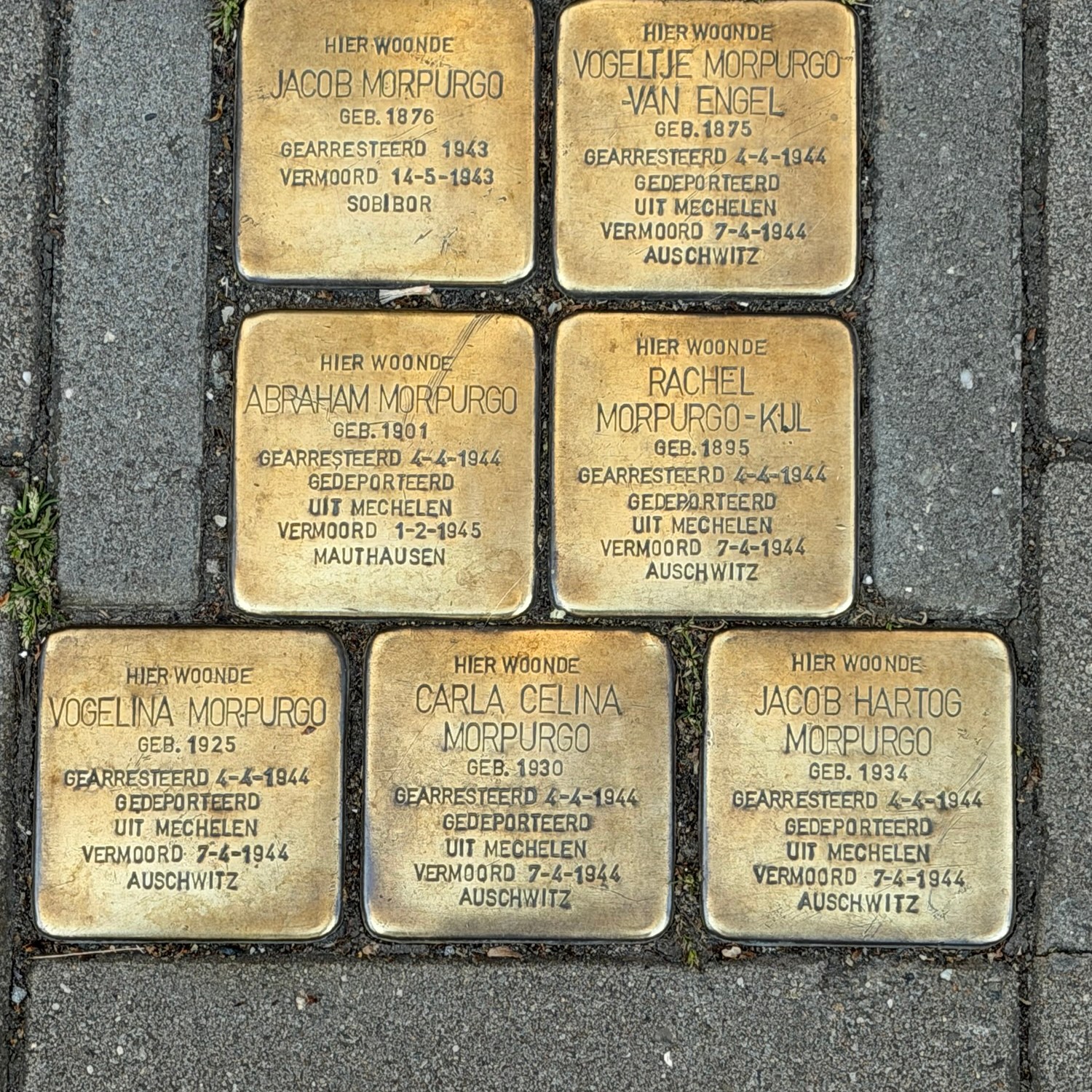
They are small monuments to people’s lives, lost in history except for these plaques, worn by the footsteps that pass over them every day. They are Jews who were arrested, interred and died in Nazi concentration camps during World War II. Whole households of as many as one I saw, with seven people.
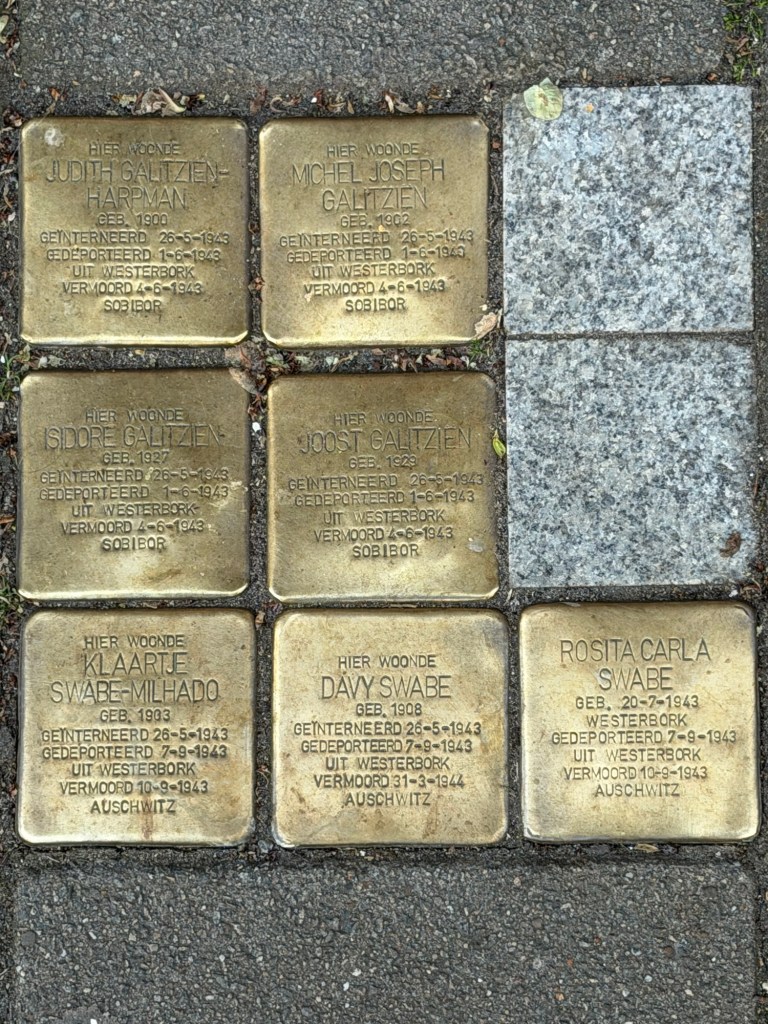
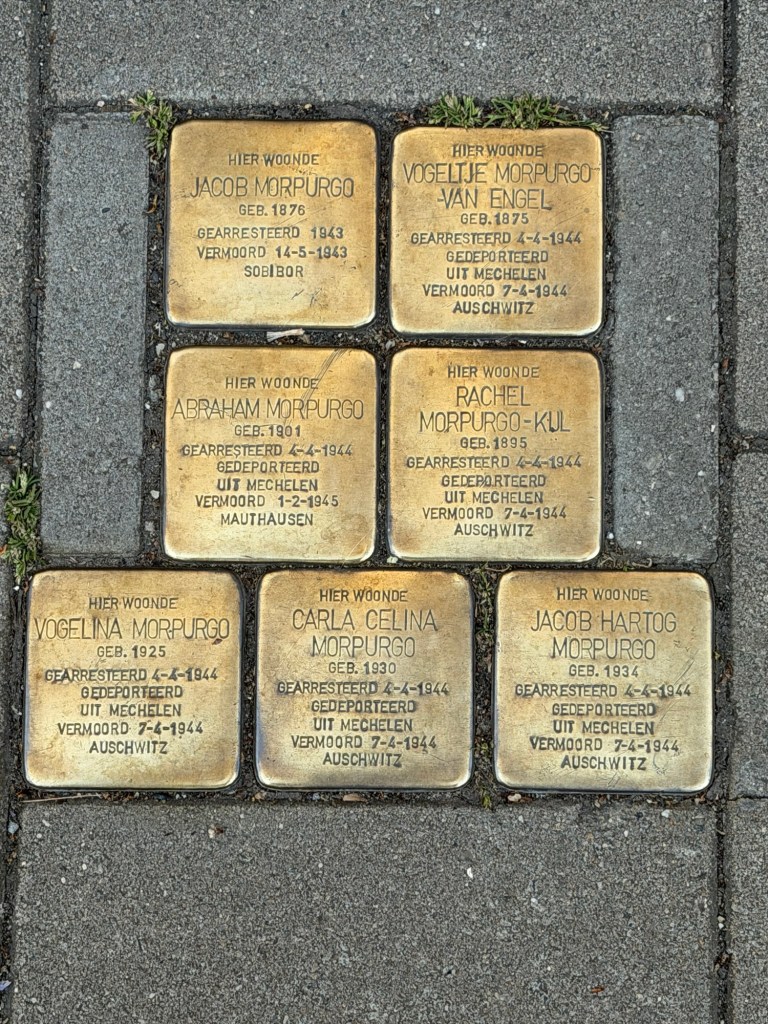
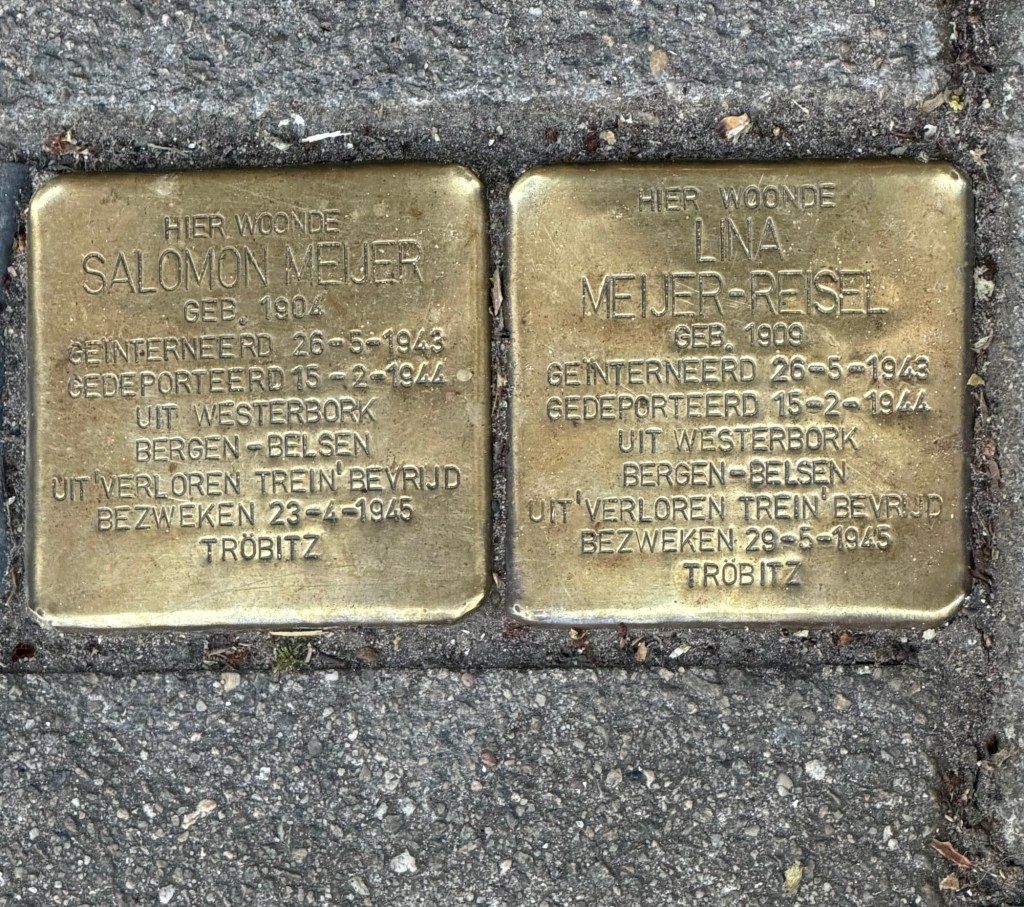
These memorials were on one side of one street, within a few blocks of each other.
You’ll note the plaques show the name, the date they were arrested, deported, died and at which camp- some households had individuals going to more than one camp (one had members at three camps). Over 107,000 Dutch Jews were deported, and the deliberate separation of families was a key aspect of the systematic destruction of the community.
Families were often separated and sent to different concentration camps due to Nazi selection processes in transit camps based on age, gender, working capability, or specific “exemptions”. Families were systematically broken up during transports to different, often changing, killing centers such as Auschwitz-Birkenau, Sobibor, or forced labor camps.
Men, women, and children were often separated immediately. Those deemed fit for labor were occasionally sent to different labor camps, while children, the elderly, and women with small children were frequently sent directly to extermination camps.
Tröbitz: Between April 8 and 10, 1945, 7,500 prisoners from Bergen-Belsen were transported by train to Theresienstadt in three separate trains.
The first was liberated by American tankers near Magdeburg within a few days. The second reached Theresienstadt around April 20. Theresienstadt was no longer an option, and the last of these three trains, also known as “Der verlorene Zug” or “Der Zug des Verlorenen (English: “Lost train”),” was not liberated until April 23, 1945, near Tröbitz, after a long journey through Germany, by Soviet troops.
By then, 198 of the prisoners had died. In the weeks following the liberation, another 320 people died from exhaustion and disease.
Sobibor extermination camp was a dedicated Nazi death camp in eastern Poland, operational from May 1942 to October 1943 as part of Operation Reinhard. It was designed for the systematic murder of approximately 170,000 to 250,000 Jews. Extermination, not concentration or labor. Almost all arrivals were murdered immediately in gas chambers using carbon monoxide. Following an armed prisoner uprising on October 14, 1943, the Nazis liquidated the camp.
Mauthausen Concentration Camp, located in Austria near Linz, was a notorious Nazi camp (1938–1945) known for its exceptionally harsh regime and forced labor in the quarry. Nearly 190,000 people were deported, tens of thousands of whom died from murder, exhaustion, or starvation. The camp was liberated by American troops on May 5, 1945.
Auschwitz-Birkenau (1940–1945) was the largest Nazi German concentration and extermination camp, where over 1.1 million men, women, and children—primarily Jews—were murdered. Located in occupied Poland, it functioned as a key site of the Holocaust and a forced-labor camp. Auschwitz II-Birkenau: The primary extermination center, where most victims were killed in gas chambers. It was designed to hold over 100,000 prisoners and held the largest concentration of inmates.
I have been to Dachau , near Munich, and the bare remnants of the camp and photos can’t possibly convey the horrors of a concentration camp, of gas chambers and crematoriums that brought death to tens of thousands.
The demonization of minorities, religious, racial and ethnic groups that took place then, still happens in the 21st century. Political leaders, nationalist demagogues, use these groups as focal points to incite fear, hate, distrust, “pollution” of race or maintaining their own view of “cultural purity” (sound familiar?) as a tool to implement mass deportation, when their only real “crime” may have been wanting a better life for themselves and their families, economic opportunity, fleeing from crime, poverty and wars in their home country. But they have become pawns in politicians’ appeal to constituents whose underlying racism and bigotry echoes their own.

