Trip 52
December 19, 2025
We’ve planned to visit Oxford when in London, on previous trips, but whether it was miserable weather or just other things to see, had not made it a priority until this trip. When planning the day excursion to Oxford, we quickly realized that there’s so much to see, that we’ll only be able to see a small part of it on a day excursion.
We booked a one hour guided tour through the Bodleian Library, the second largest library in the UK (after the British Library in London) and the largest research library. The train we booked to Oxford from Paddington Station was cancelled early this morning (no explanation), so we scrambled a bit to book one (higher price) that left only 15 minutes later, requiring one change in Reading. The train to Reading was a high speed train, clocking a speed at one point of 123 mph.

The train from Reading to Oxford wasn’t a high speed train, but the scenery was beautiful; pastoral landscapes, gently rolling hills, farms, fallow fields , though some fields were planted in a winter crop. Unlike yesterday, the weather today gave us blue skies, with the winter sun shiny brightly.
There was no papal bull that formally establish Oxford University , but there is evidence of teaching as early as 1096 (only 30 years after the Norman conquest of England) making it the oldest university in the English-speaking world. The University developed rapidly from 1167, when Henry II banned English students from attending the University of Paris. This timeline means Oxford can lay claim to nine centuries of continuous existence.
Since our tour of the Bodleian wasn’t until 1:30, we had a few hours to explore the city , walking from the train station to Oxford University. The city has a number of self guided walking tours and we’d picked one part of one walking tour (Inspector Morse City Trail) to start, which included the Randolph Hotel, an elegant hotel in the heart of the city that was the location of several scenes in the British TV detective series called Inspector Morse.
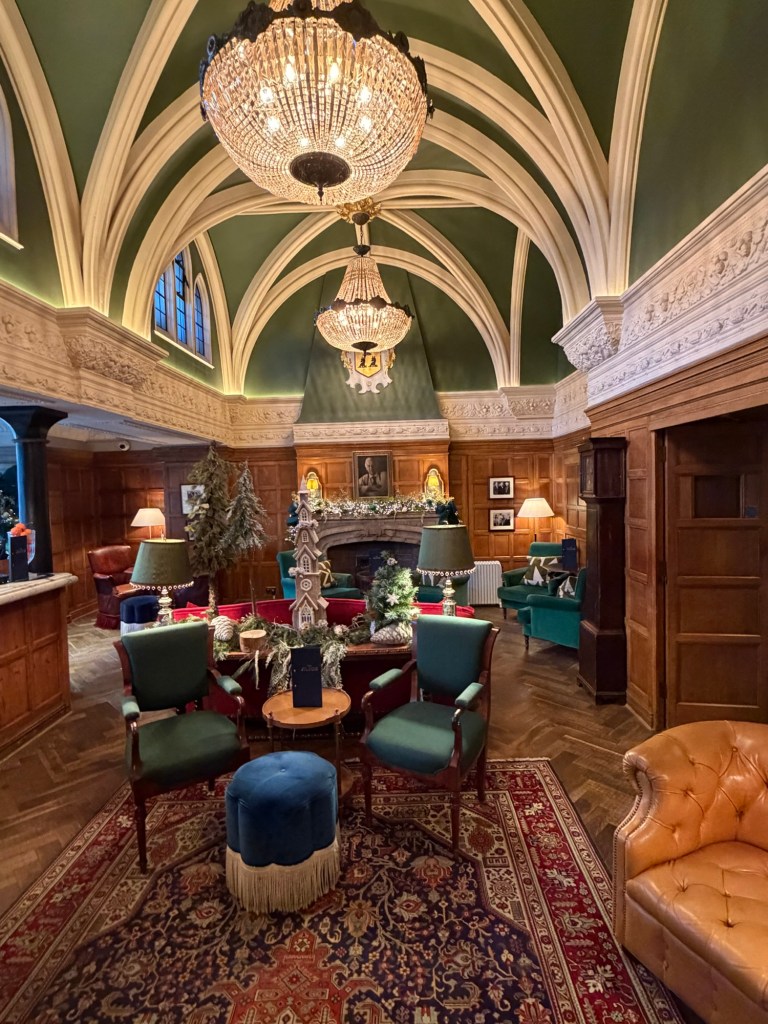
There were several other places we had in mind as well, but once we got to Trinity College, found the grounds were closed to visitors (likely due to Christmas holidays). We visited points 5,6, 8, and 9 in the course of walking around or during the course of our tour of the Bodliean (see tour map) . Blackwells Booksellers on Broad Street was like Daunt Books on steroids, with huge collections.
We had a pub blunch (breakfast/lunch) just across from Blackwells, at The Kings’ Arms pub. The King’s Arms pub in Oxford has a back bar lined with photographs and mementoes of its literary associations, which can be seen in interior photos. Authors linked to the pub include Graham Greene, John Mortimer (whom we met at a book signing many years ago).

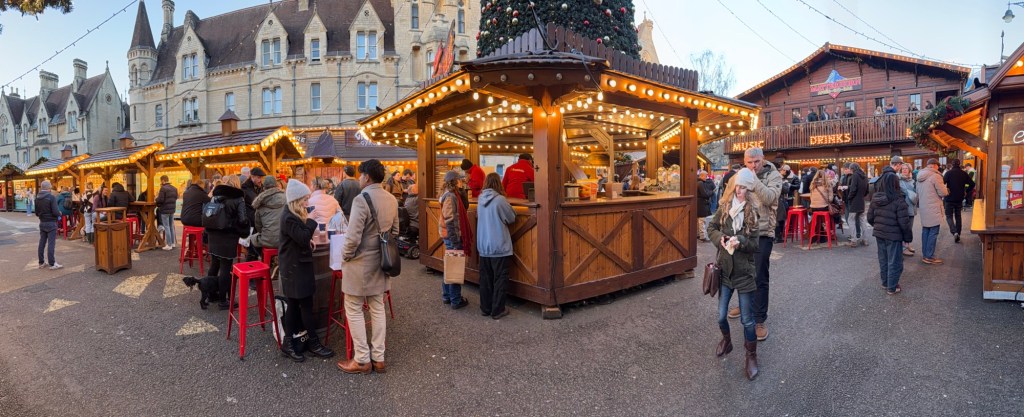
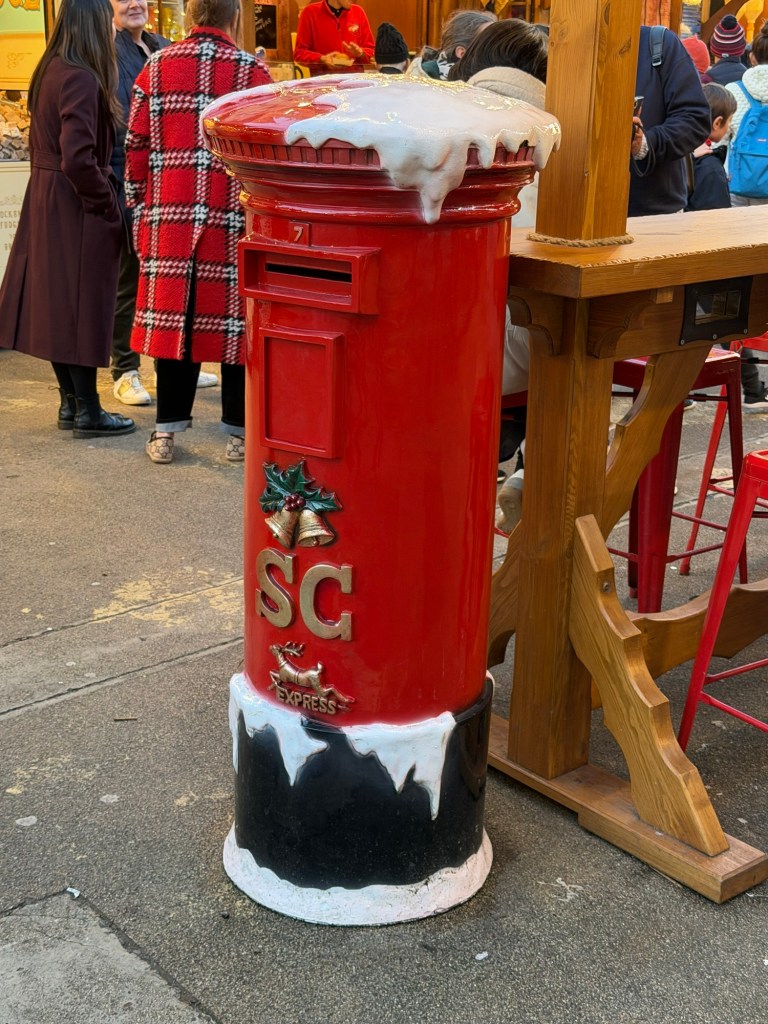
Broad street is the venue for the city’s Christmas market; I’m sure it’s plenty busy in the evenings. There are food stalls set up, with a few rides for children.
Our tour of the Bodleian Library, probably the crown jewel of the University was conducted by a British American volunteer.
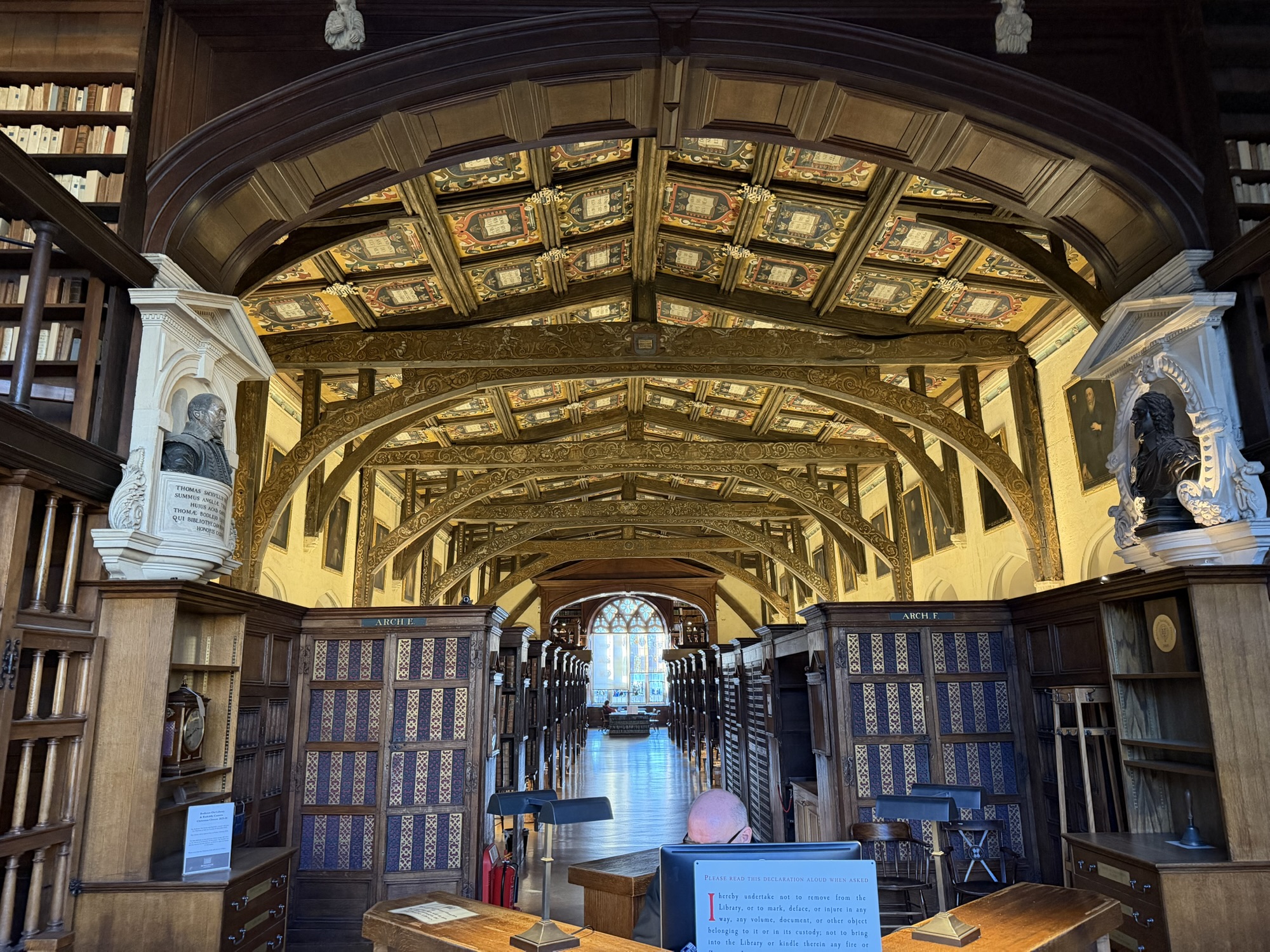
The tour begins on the ground floor, site of the divinity school (made even more famous from Harry Potter films). The Bodleian Library itself begins on the 2nd floor. The divinity school began construction in 1425 ( completed 1488) and classes and exams were conducted in Latin. The complete extent of the library encompasses 14m books, but the collection which, began with the donation of 300 manuscripts, rapidly outgrew the confines of the building.

To fund the building’s construction , the school turned to wealthy benefactors and the benefactors in turn, had their gifts featured in 455 intricately carved stone decorative protrusions in the ceilings, designed by William Orchard in the 1480s, depicting benefactors’ family crests/initials, religious symbols, flora, fauna, and even stonemasons’ marks.
Through a connecting door, you come to the Convocation house (built 1635) , a room which served many purposes throughout its history. Originally built to serve as the meeting room for the (then) 26 colleges (now 39) that formed the University, at various points the room also served to house the King and his court when it moved from London (twice)- once during the English Reformation (Charles I) the King lost the war and his head) and again when the court moved after the Great Fire of London (Charles II).
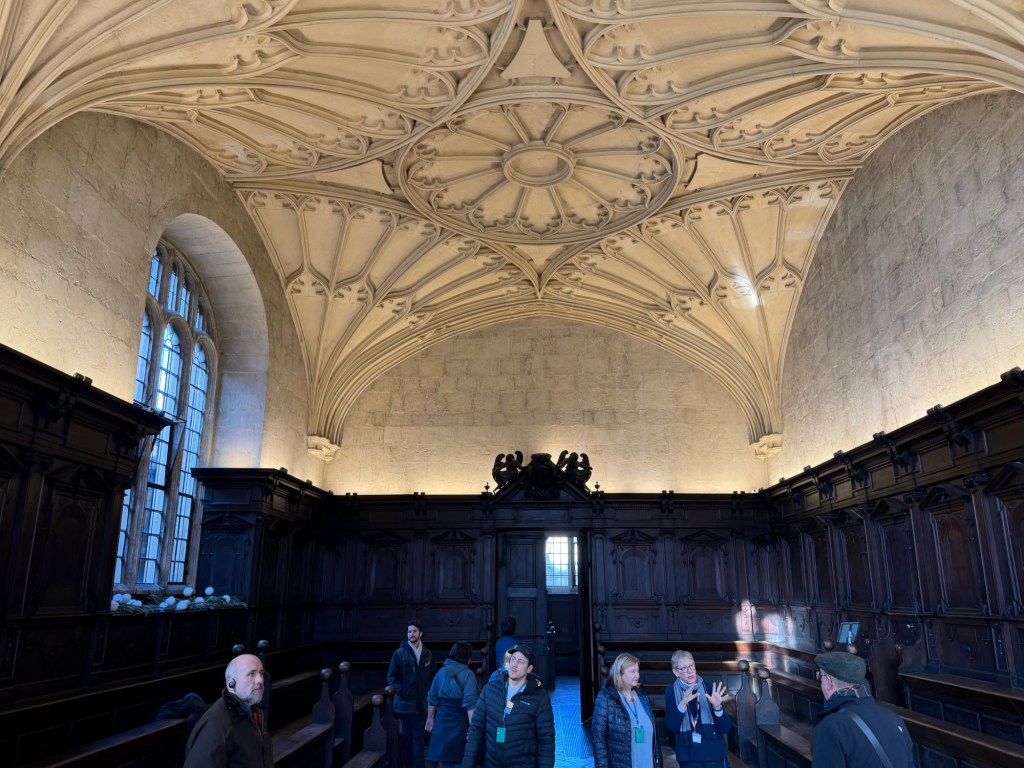
The tumultuous time in England’s history that was the Reformation, did not leave the University unscathed, since as a place of (then Catholic) religious study, the zealots of the Reformation destroyed most of the original 300 manuscripts donated, leaving all but 6 destroyed.
A smaller room behind the Convocation room is the Oxford University courtroom – which existed from ~1370’s to 1970’s (600 years), where Oxford University residents (“privileged persons”) legal conflicts were resolved. But the conflicts between the “privileged persons” and the residents of the city became so severe that some of the academics and students fled Oxford and founded Cambridge University
The University of Cambridge was effectively founded by scholars who left Oxford in 1209 after a dispute with the townspeople, creating a new center for learning in Cambridge. These academics, fleeing conflict and seeking a more hospitable place, formed the nucleus of the new university, making Cambridge’s origins directly tied to disgruntled Oxford scholars. In 1209, Oxford townspeople clashed violently with Oxford University scholars, resulting in the hanging of two innocent clerks by the town.
The king sided with the town, leading many Oxford scholars to disperse to other locations like Paris, Reading, and Cambridge. Enough scholars settled in Cambridge to establish a new university, building on existing academic traditions.
Oxford’s collegiate system differs from most U.S. universities through its unique tutorial system (intense, one-on-one or small group sessions with tutors, demanding independent thought and deep reading, with fewer, but higher-stakes, assignments) , depth-focused academics, specialized degrees, and semi-independent communities as integrated colleges that provide living, dining, and a smaller academic community within the larger university, contrasting with the broader, extracurricular-heavy, and often larger, less integrated campus experience of many U.S. institutions.
We climbed the stairs to the second level to view the actual beginnings of the Bodleian Library.
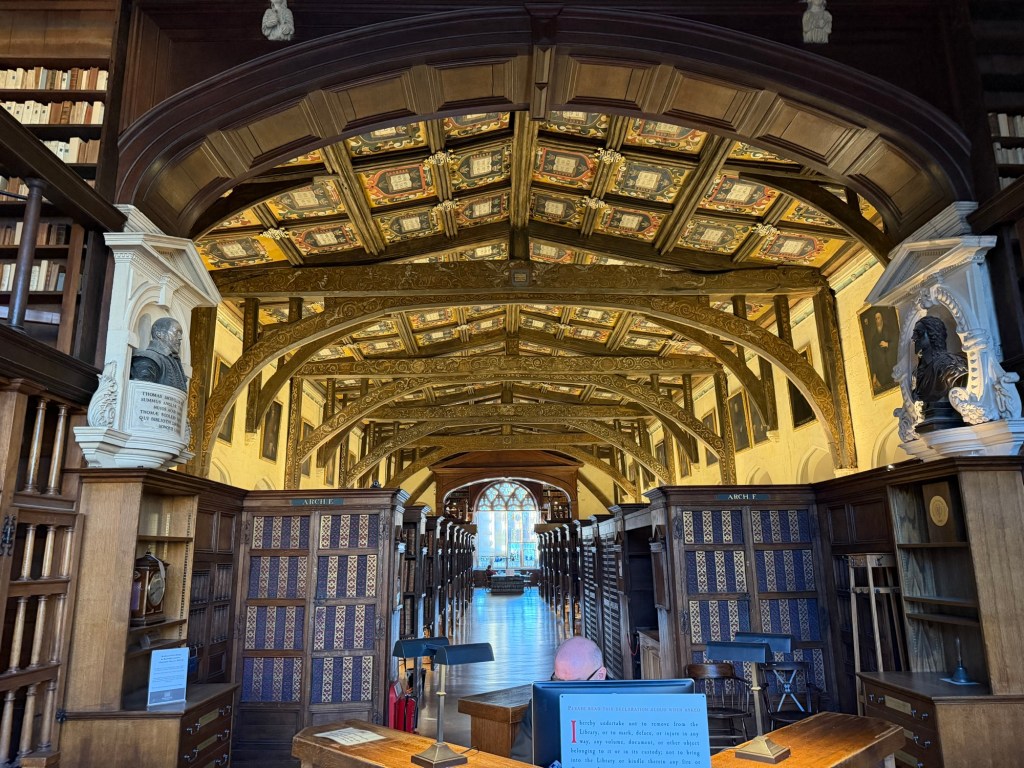
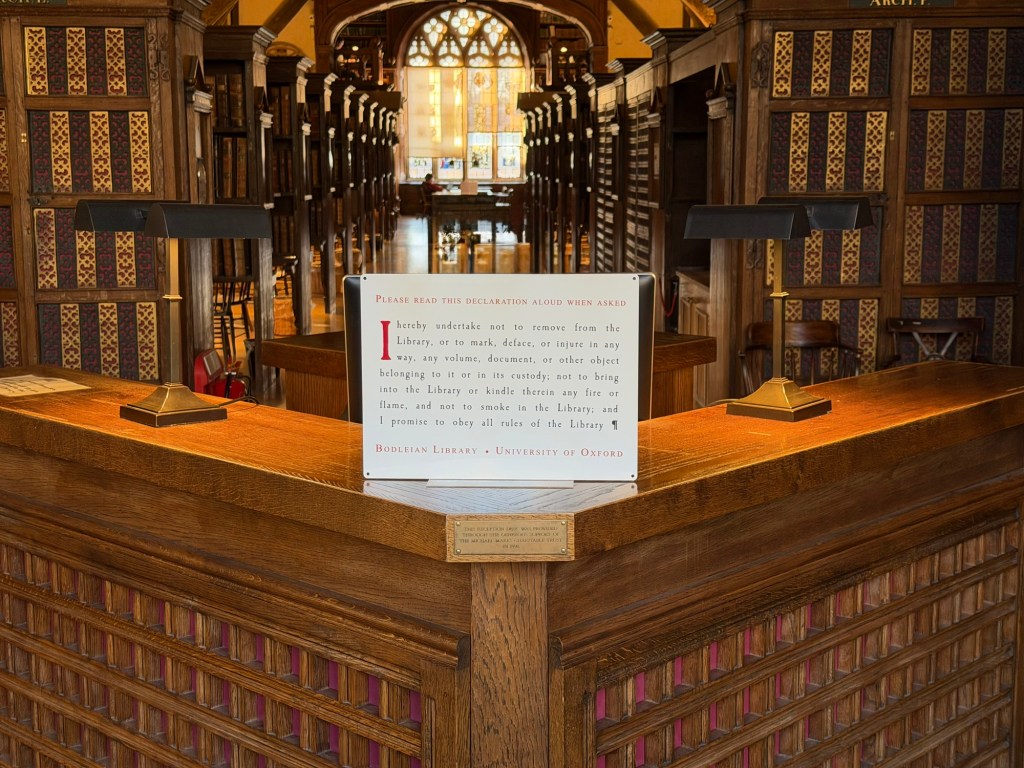
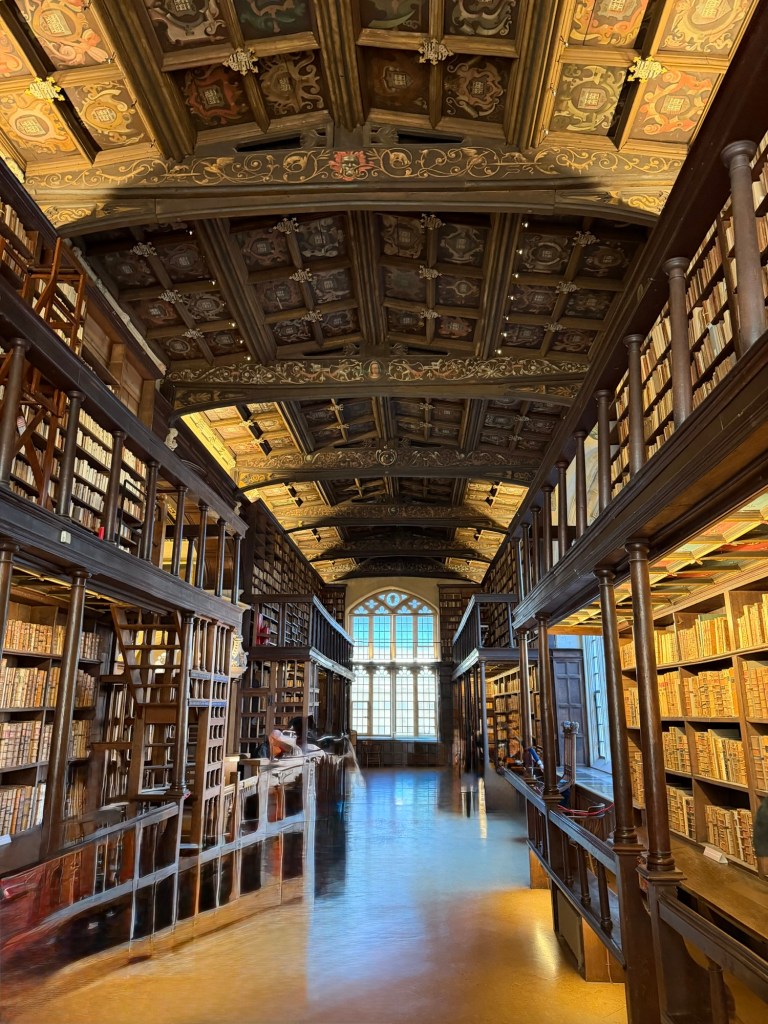
Thomas Bodley came to the university ~ age 15 and by age 21 was a professor in Ancient Greek , and after leaving the University on a sabbatical, returned to England and later became attached to the Queen’s court. It was his financial contributions that funded and rebuilt the library, in 1602. It is after him, the library is named.
He only had three rules:
1. It is not a lending library – no books can be removed. This even extended to the King himself.
2. The library is accessible to everyone, irrespective of their national origin.
3. No flames are allowed , ensuring the priceless collections do not go up in flames.
In 1910 the library was extended underground and across the street. In early 2000’s 7m books moved to Swindon because there was just no more room. The Bodleian is one of six UK libraries entitled to a copy of every book published in the UK and Ireland.
It was not until the printing press was invented that books became more widely available; until then, if a family had a book, it was likely the Bible. Otherwise books were only owned by the very wealthy. It was for this reason that books were originally literally “chained” to the shelves and the chains weren’t removed until 1750’s. If you came to the library to read, you sat in the area in front of where it was shelved, pulled the book down from where it was shelved and read in the unlighted reading rooms. The Bodleian Library unchained its books in the mid-18th century, with blacksmith Nathaniel Bull undertaking the significant task of removing chains from over 1,400 volumes between 1760 and 1761.
How do you search 14m books? https://www.bodleian.ox.ac.uk/collections-and-resources/solo
Outside the Bodleian Library is the ”Quad”, conceived by Bodley, who did not live to see its completion, but whose will donated the funds for construction. It is a legacy that has endured for over 400 years. His fitting legacy is similar to a Greek proverb: “A society grows great when old men plant trees in whose shade they know they shall never sit.”
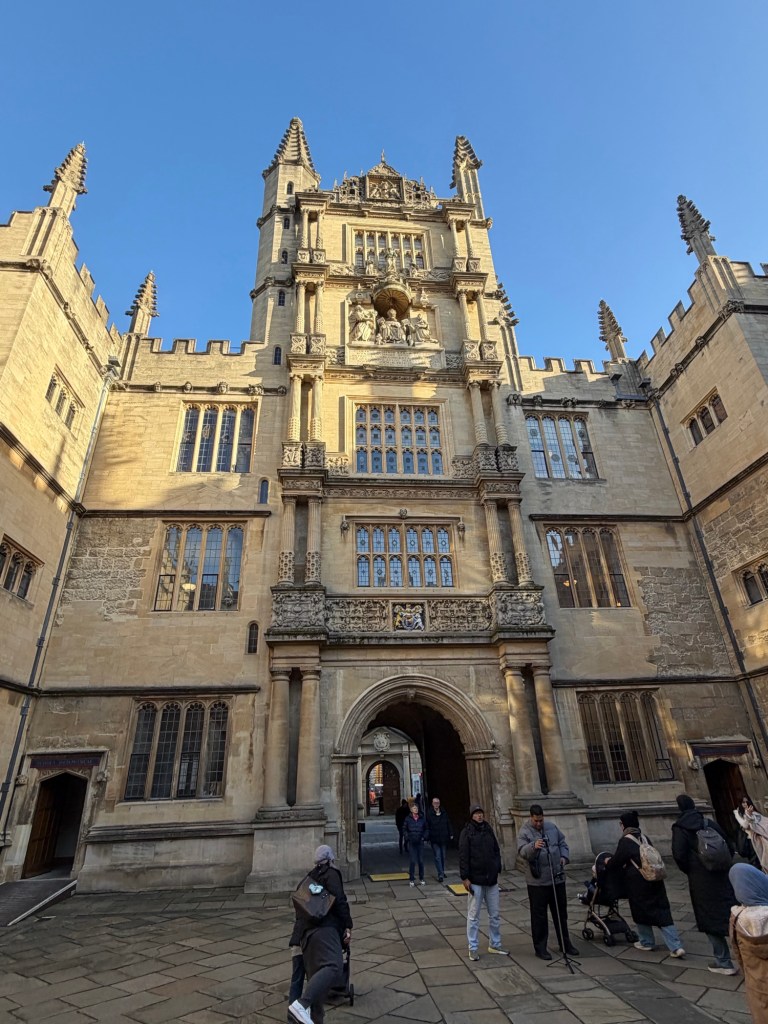
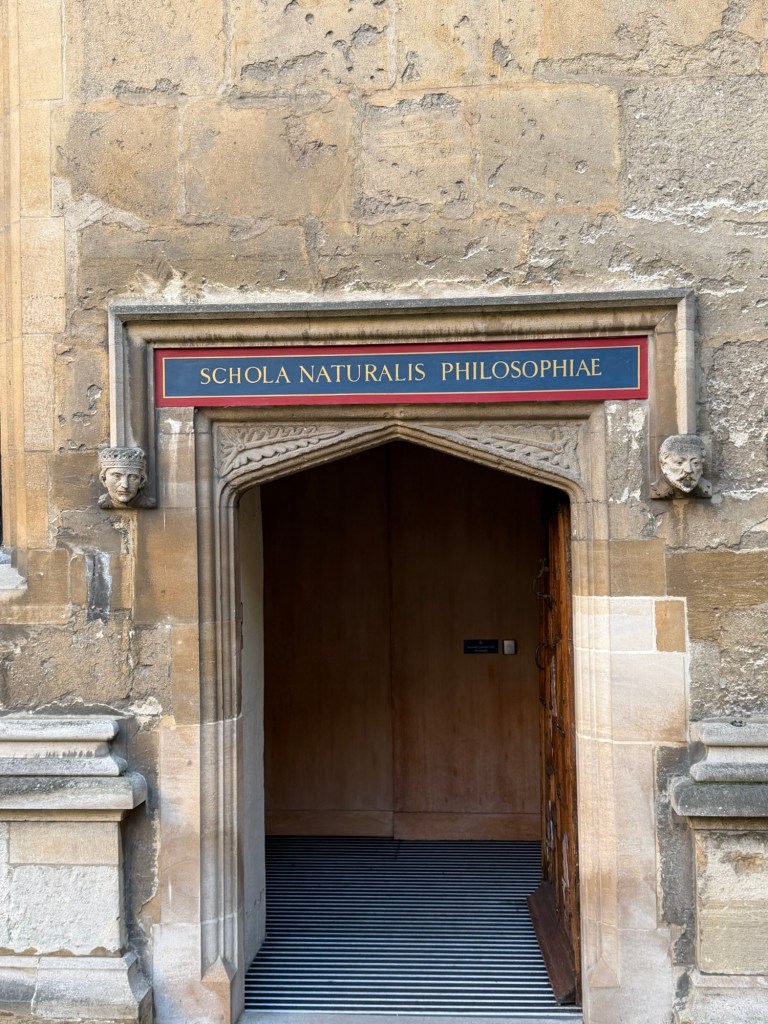
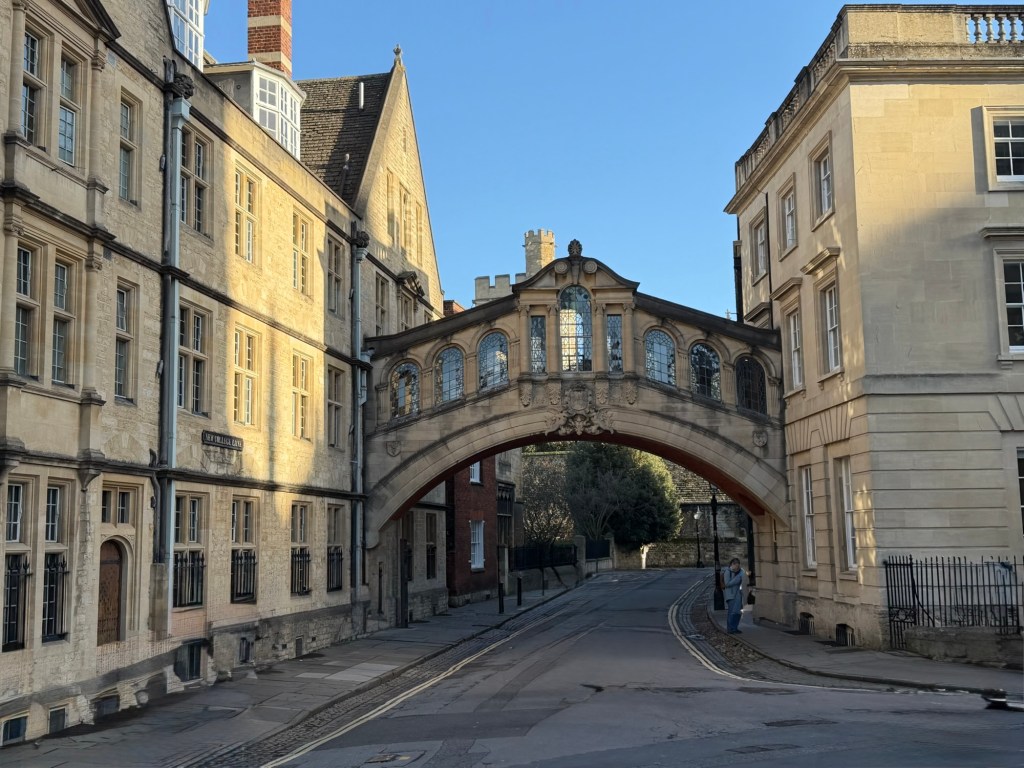
Outside and across the street from the courtyard is the “Bridge of Sighs” though officially known as Hertford Bridge, is a distinctive covered skyway connecting two parts of Hertford College over New College Lane, known for its unique design and popularity as a photo spot, named after Venice’s famous bridge, though not a replica, and built around 1914.
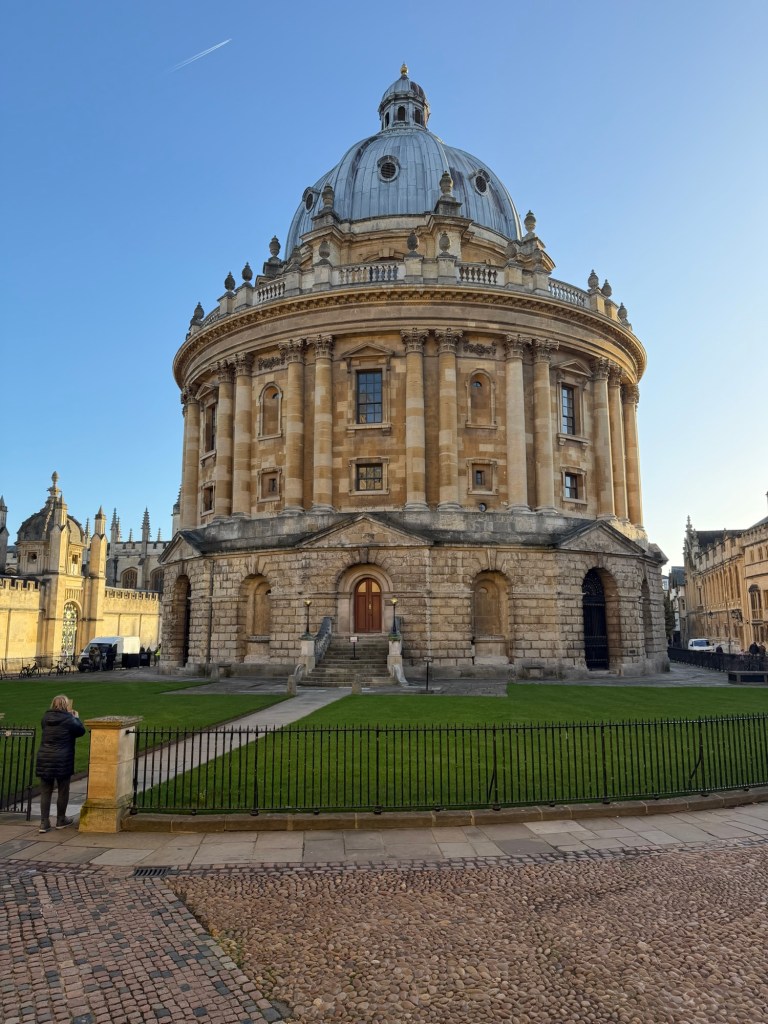
The Radcliffe Camera is an iconic, domed, neoclassical library building in Oxford’s Radcliffe Square, part of the Bodleian Library, designed by James Gibbs and built 1737-1749,, known colloquially as “Rad Cam,” and still used by Oxford students today as a reading room. Its name comes from the Latin “camera” (room), housing science books, with underground tunnels connecting to other Bodleian sites.
There is so much more to see in Oxford and the historic colleges and museums than a day trip here could possibly encompass.
 TerraTraveler