Trip 50
April 26, 2025
I hadn’t intended to write a post today since today was mainly shopping, but there were a few things that we experienced that were interesting. Tokyo ( the city and not the metro area) has a huge population ~14 million . The country has had an aging population for some time and this has contributed to a few lost decades of growth. I don’t have the exposure to their media to have an appreciation of issues that might divide them, as many other countries do (and not just the US), but I get the sense that in society here, there’s less a focus on the “individual “ than being part of the whole. In Japanese society,the emphasis is on group harmony and collectivism, with the needs and desires of the individual often taking a backseat to the needs of the group. This manifests in various aspects of life, from personal relationships and work to social norms and even language; this is a stark difference to my home country ( US); that’s why it was surprising to me to see the protests taking place.
Historically, because Japan is exceptionally ethnically homogeneous (because of its geographic isolation, just like Iceland) , with only a small non-Japanese minority (consisting mainly of Chinese and Koreans), it has had the notable advantage of not having to face the same problems of ethnic politics that have complicated the process of modernization and political development in many Western societies (UK, EU and US in particular) . Yet, in Japan, urbanization, industrialization, and other aspects of modernization have taken place so rapidly since the end of World War II , (when so much of society was upended due to the war) that they have brought about socioeconomic and value changes. As in any society, change is difficult to percolate throughout the many levels, especially in a country and society that values tradition and ceremony.
Culture here is very different than our own (politeness and respect seems to be imbued in all the interactions we’ve had with the people of Japan), but of course, we have a very limited exposure. Even seemingly mundane things like all the train conductors, police, security personnel, taxi drivers, all wear white gloves and neat uniforms. You’re always greeted when you enter a small store and when a store attendant hands you a receipt or your credit card, they do so with both hands. Receiving with both hands shows respect for the person and acknowledgement. Even business cards are exchanged with both hands.
I think “tech” shows itself here in different ways that we’ve experienced. We went to a huge clothing retailer called Uniqlo in Ginza. We bought a few small things, but the interesting part of the experience is that self-checkout was this process— we had our few items in one of their shopping bags. Put the shopping bag with our items into the holding area next to the pay terminal. Didn’t scan anything. It came up with the correct price. Tap to pay and done. How’d it do that? Weight? Some electronic tag (wasn’t apparent)? Don’t know. Trying things on in the dressing room? Take your shoes off.
I later looked into the checkout experience and found that Uniqlo uses RFID technology, with RFID tags embedded in the price tag, enabling them to know the price, size, etc of all that you buy without any interaction with a cashier.
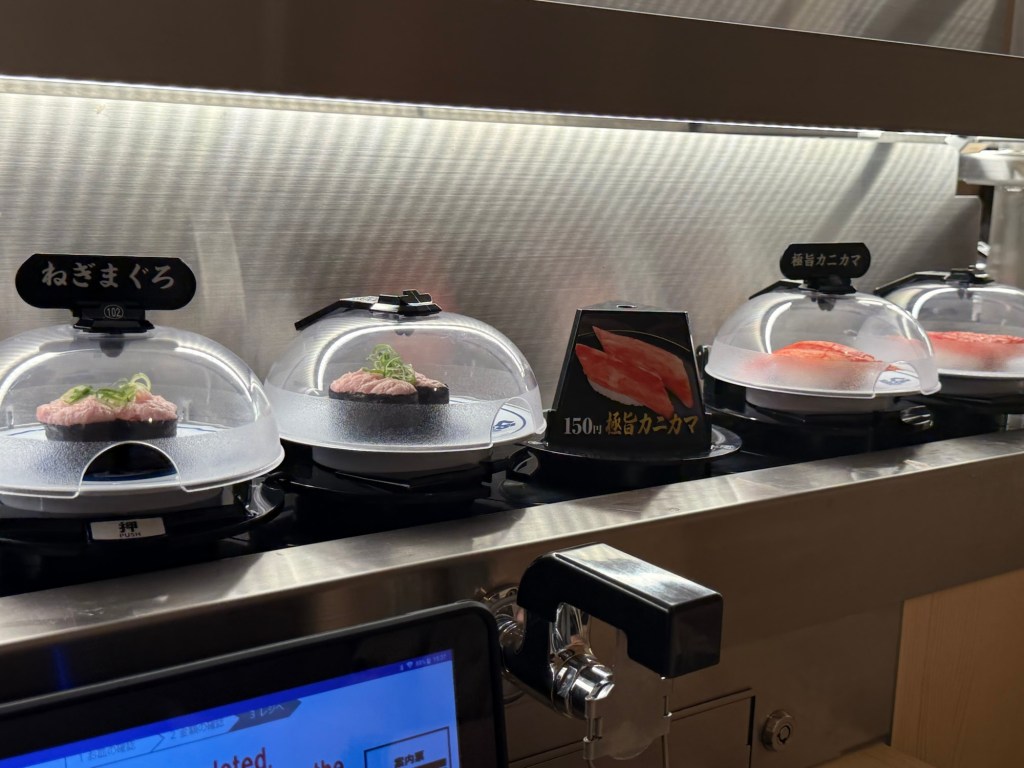
We went to the top floor of the same building for a late lunch (Kura). Check in on a screen that gives you a number. Wait for your number to be called/shown on a screen, then an actual person (!!) gives you a slip of paper with your table #, directs you to a cubicle where you use a touchscreen to place your order. The items arrived (literally zipping up on a conveyor belt next to you). When you are finished with a dish, there’s a slot to put the dish into. Once you are ready to check out, go to a self-checkout terminal where you scan the piece of paper that has the table #, it pulls up your ordered items, touch your credit card to the terminal and, you’re done. Very inexpensive.
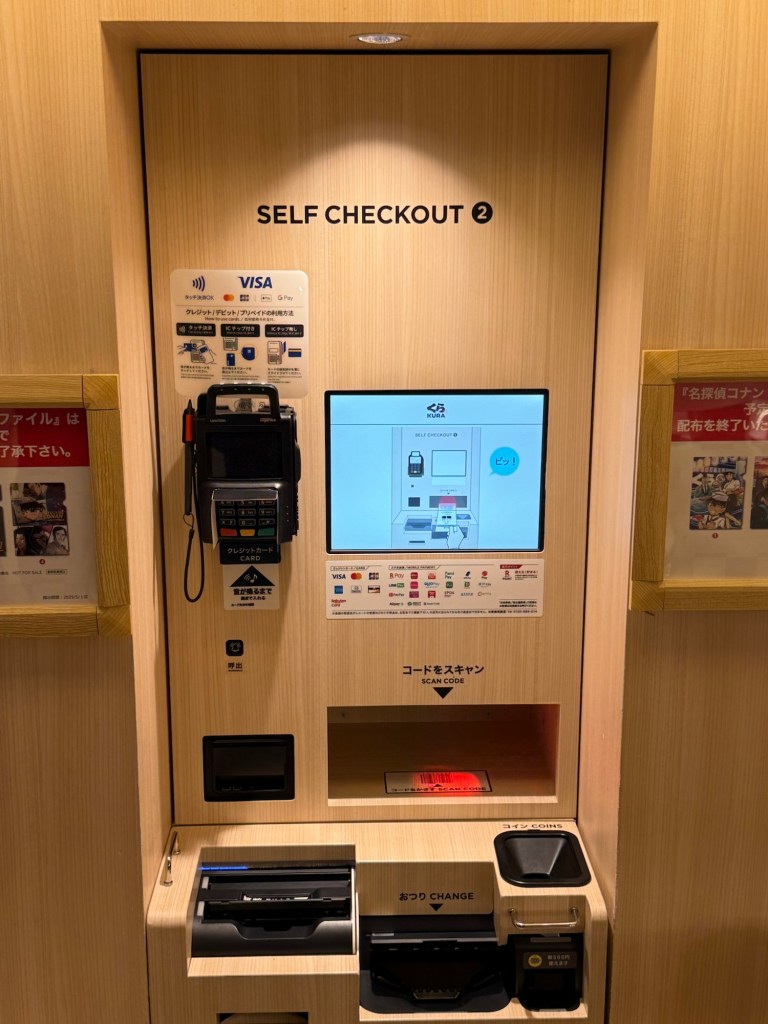
Touch to pay isn’t as widespread here ( I’m sure the terminals are more expensive) as at home, cash still widely used, but also an electronic prepaid card (Suica) that you can top up (using a credit card) and use both for transit and purchases.

 TerraTraveler