Trip 48
November 7, 2024
The Cathedral was closed, for services, when we first went by two days ago, but it was open for visitors today.
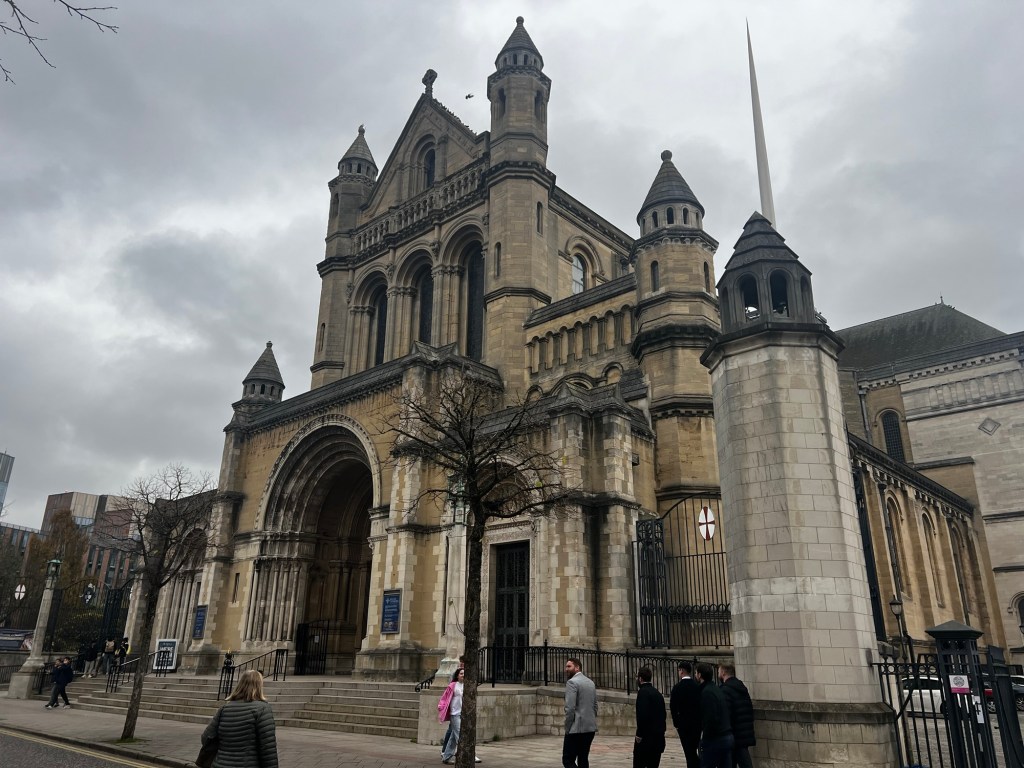
Like some churches , they charge a small amount for admission, as maintenance on older buildings is quite expensive.
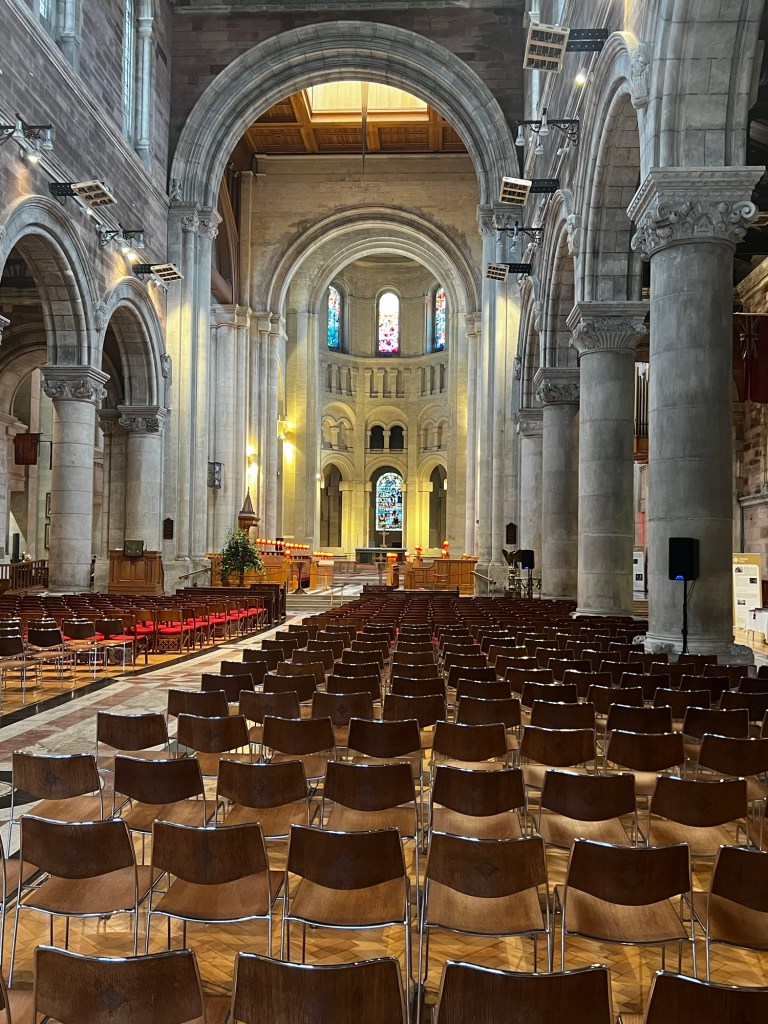
The foundation for the Cathedral was laid in 1899, built around the existing parish church of St Anne’s (built 1776). The old church was demolished at the end of 1903 and six months later, the Nave of the Cathedral was opened for public worship. Work on the cathedral continued for over a century, with the most recent addition the stainless steel Spire of Hope, in 2007.
A 210ft bell tower was originally intended to be built for the Cathedral, linked to the ambulatory. However, because the ground the Cathedral is built on could not support the weight, a competition was organised to find a designfor a spire. Beneath large areas of the centre of Belfast, are deposits of wet estuarine clay, known locally as “sleech”. Since it has never been subjected to pressure it has not been consolidated and gives very little support for the building. The Spire of Hope won this competition as its lightweight, innovative design ensured that additional strain was not placed on the Cathedral.
The Baptistry was completed in 1924 with the design incorporating the elements of Earth, Air, Fire and Water. There are 150,000 pieces of Italian glass making up the mosaic, each placed by two nuns.

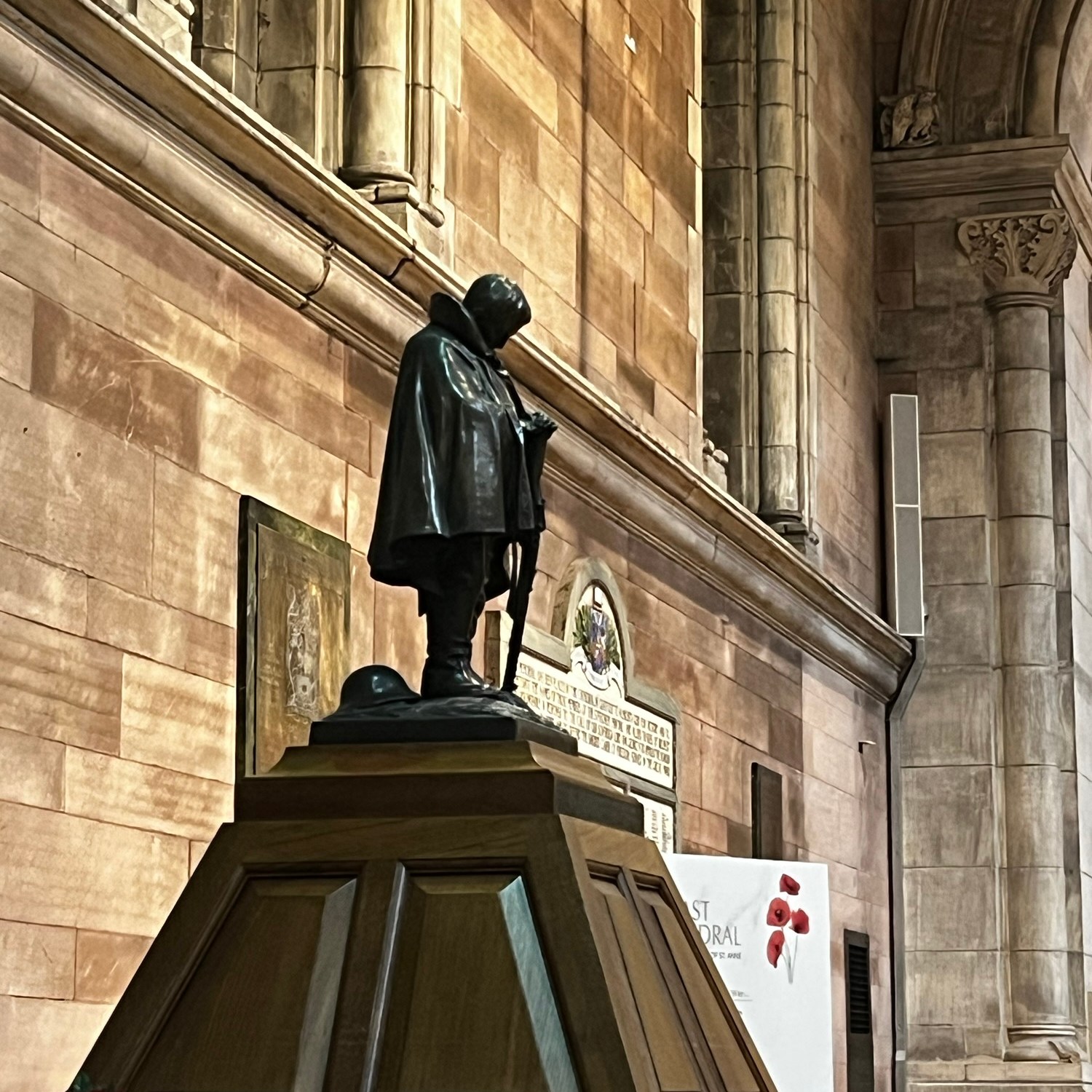
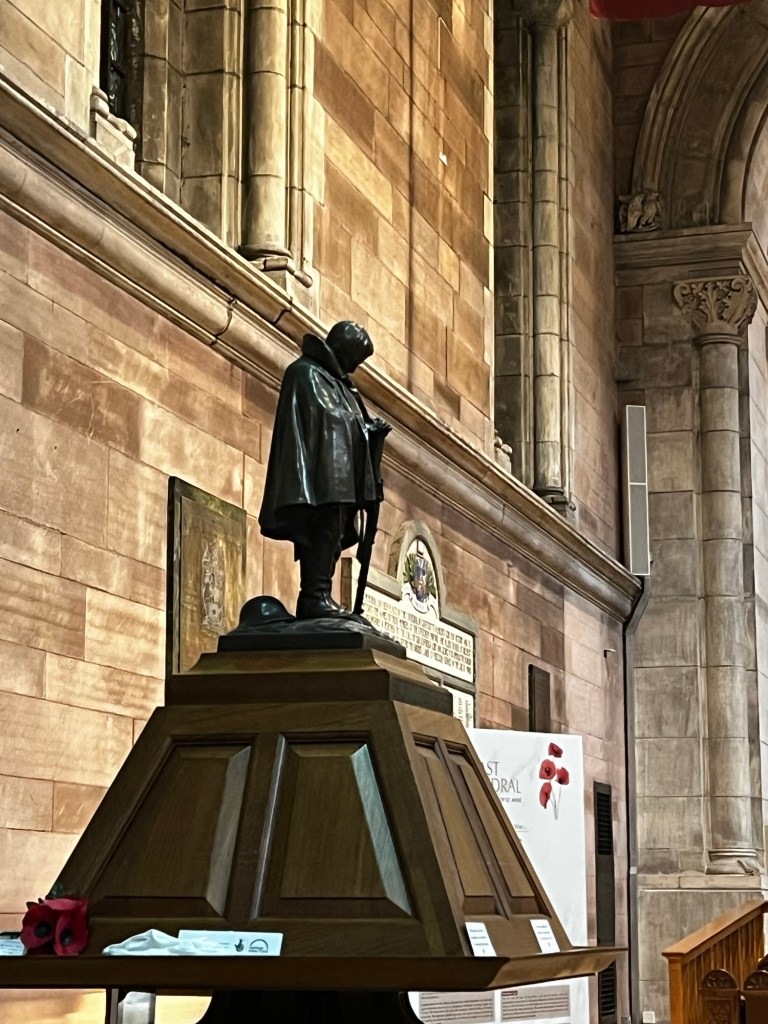
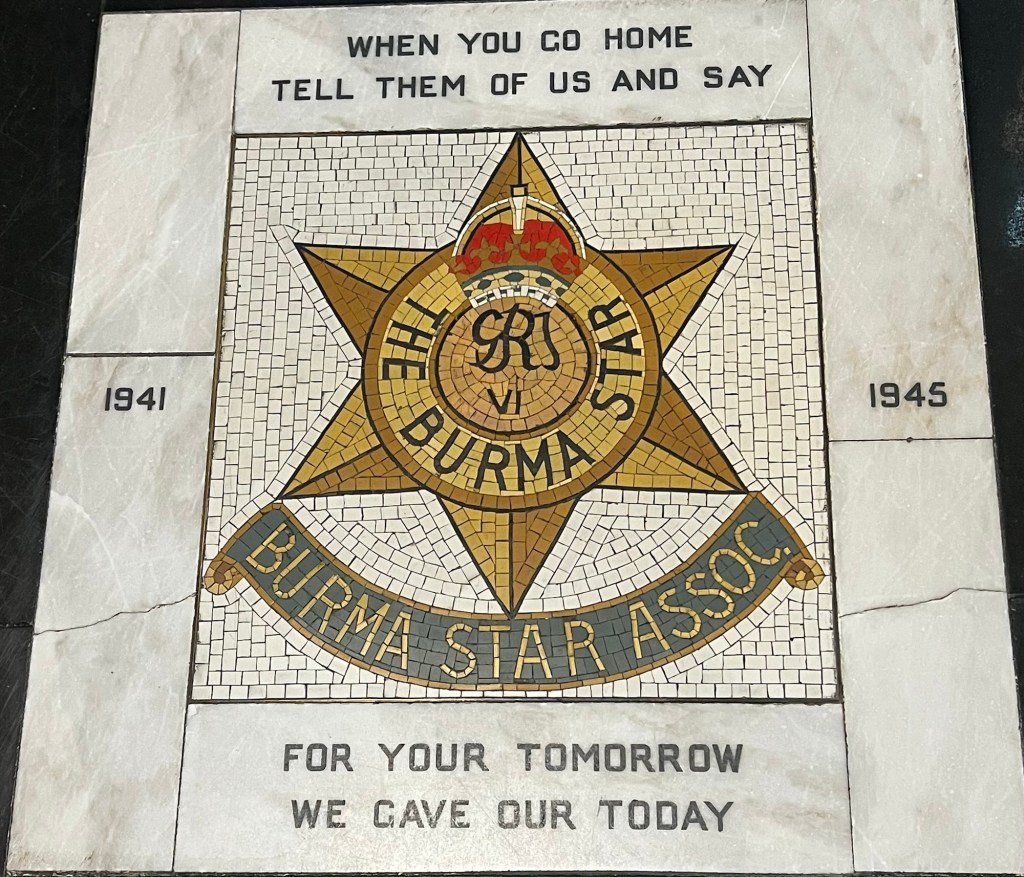
There are chapels and monuments along the sides of the Nave, behind the choir, dedicated to military units (Royal Irish Rangers) and the many battles in which they were engaged and to those who died defending Britain in World War I and II.
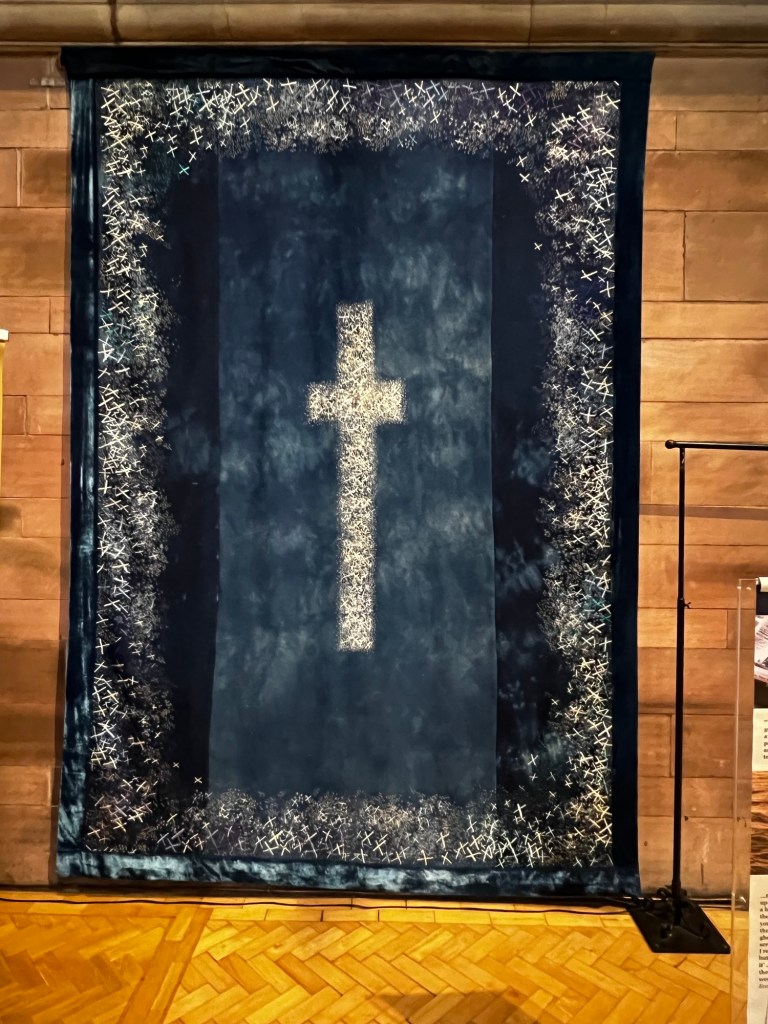
The Titanic Pall, in the opposite side of the Nave U.S. is dedicated to the 1517 souls who perished. It was dedicated on the 100th anniversary of the disaster April, 1912). Each of the gold crosses on the Pall commemorates someone who died.
We had an interesting conversation with the attendant about his/general perceptions about the US presidential election (during which he portrayed Trump being re-elected as appalling).
After leaving the Cathedral,we walked on for about half a mile to the Belfast Crumlin Road Gaol (jail). The Gaol was initially built in 1841, with the first prisoners arriving in 1846.
The first prisoners arrived, marched in chains from the county Gaol in Carrickfergus. While, now, it’s only 12 miles by road, marching in chains would have been quite an ordeal. The total number of prisoners was 106, consisting of six awaiting deportation, 17 serving sentences (6 of whom were described as lunatics) and the remainder awaiting trial.
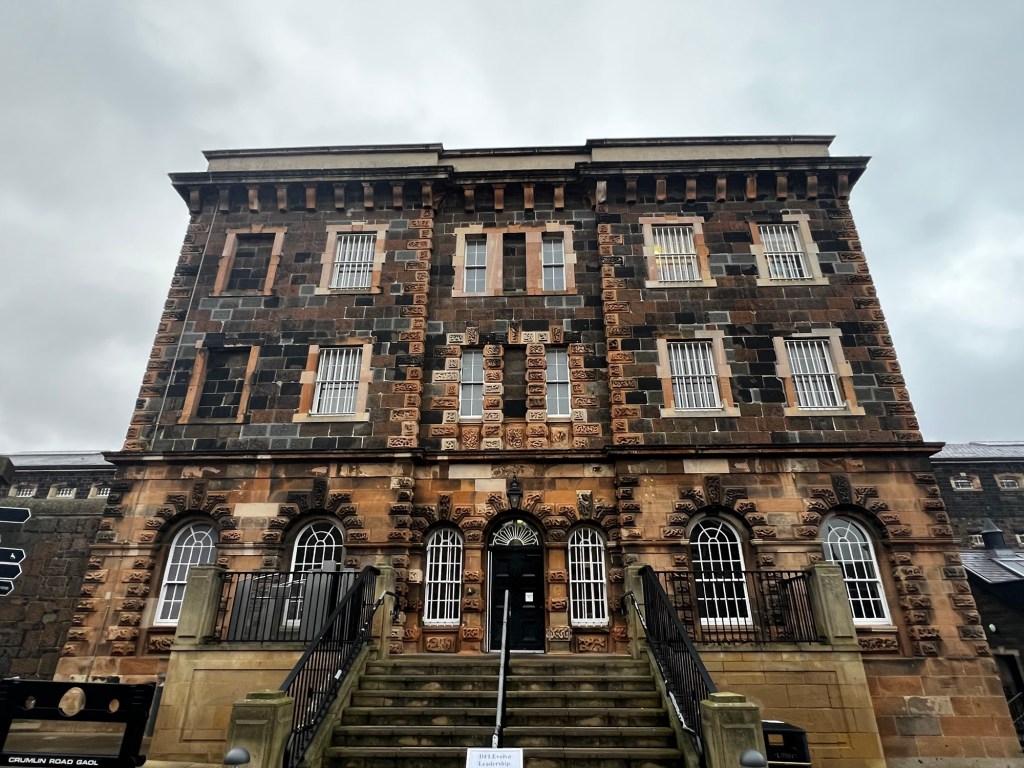
In 1849-50, further additions to the Gail were made, including an underground tunnel from the courthouse across the street so you could walk underground to your new home directly after conviction.
In 1889, the law in Britain offered the death penalty for some 200 offences including being in the company of ‘gypsies’ for 1 month, vagrancy for soldiers and sailors, stealing a loaf of bread and cutting down a tree.
1908: During the period of January – September, there are a number of young male prisoners from the age of 14 years being held at the jail. Among these are young and older males being held for 24hrs to 72hrs as a consequence of playing football on the streets.
1908: The Children Act is introduced. The Act stipulates for the first time a minimum age of 16 years for someone to be executed for murder.
1854 marked the year of the first execution. Others followed in 1863, 1876, 1889, 1894,1922,1924, 1928,1930,1931,1932,1942,1961 (the last prisoner to be executed here).
But inmates weren’t all “criminals “. In 1914, Suffragettes were imprisoned in the Gaol.
The first outbreaks of suffragette violence in Northern Ireland occurred in 1912. There were further outbreaks of militancy during 1913 and 1914 which climaxed with a bomb attempt on the Church of Ireland.
1930: The Criminal Appeal Act is passed. Up until this, there is no right of appeal for a conviction on indictment, not even for murder Instead an appeal for clemency is made to the local government, and the cabinet decides if it is worthwhile notifying the Lord Lieutenant for Northern Ireland with a recommendation for clemency.
By 1942, the prison held over 700 inmates.
In 1972, Lord Diplock reviewing the judicial system made the recommendation of the suspension of jury trials.
The Northern Ireland (Emergency Provisions) Act of 1973 gave the recommendation legislative expression and was further approved in the House of Commons by a single vote, Today, there is still legislation covering these trials. The Northern Ireland (Emergency Provisions) Act of 1991.
The prison closed March 31,1996. The courthouse across the street closed a few months later. The courthouse is a derelict building, having been sold several times for redevelopment that haven’t as yet taken place.
The introduction of trial without jury took place during the time referred to as “The Troubles”.
While “The Troubles” seemingly are in the past, walk a few blocks behind the courthouse and you’ll see strong evidence of nationalism still seething in the open , unionism (remaining part of Britain), anti-Catholicism, anti-Irish (anti-Republican).
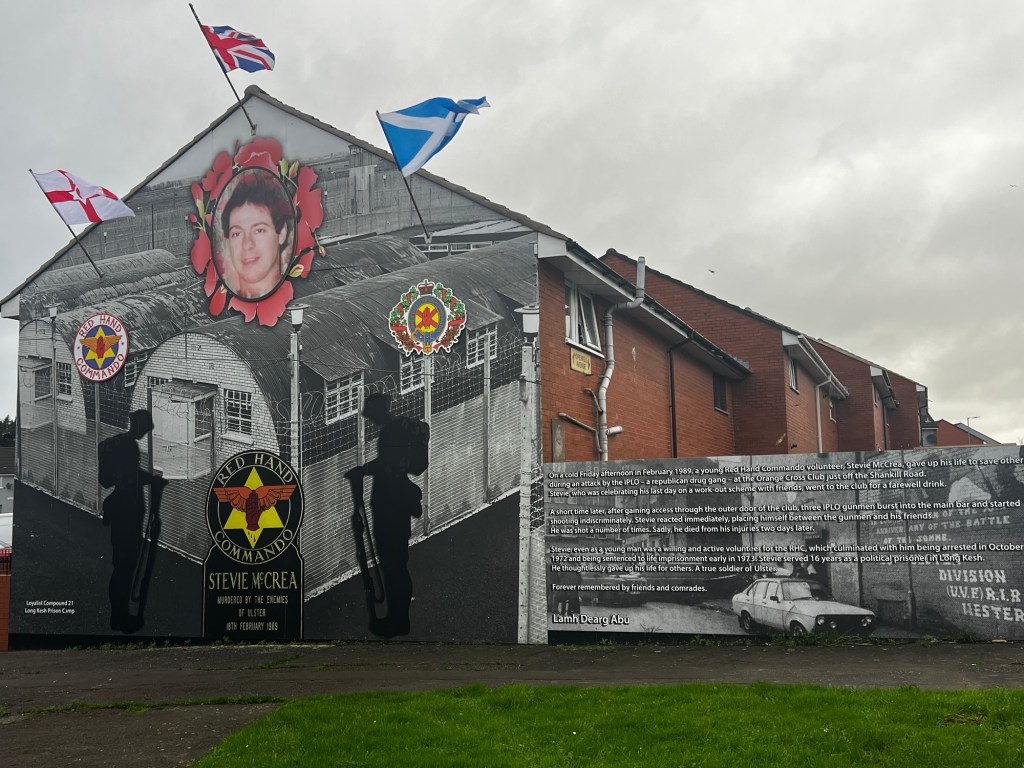
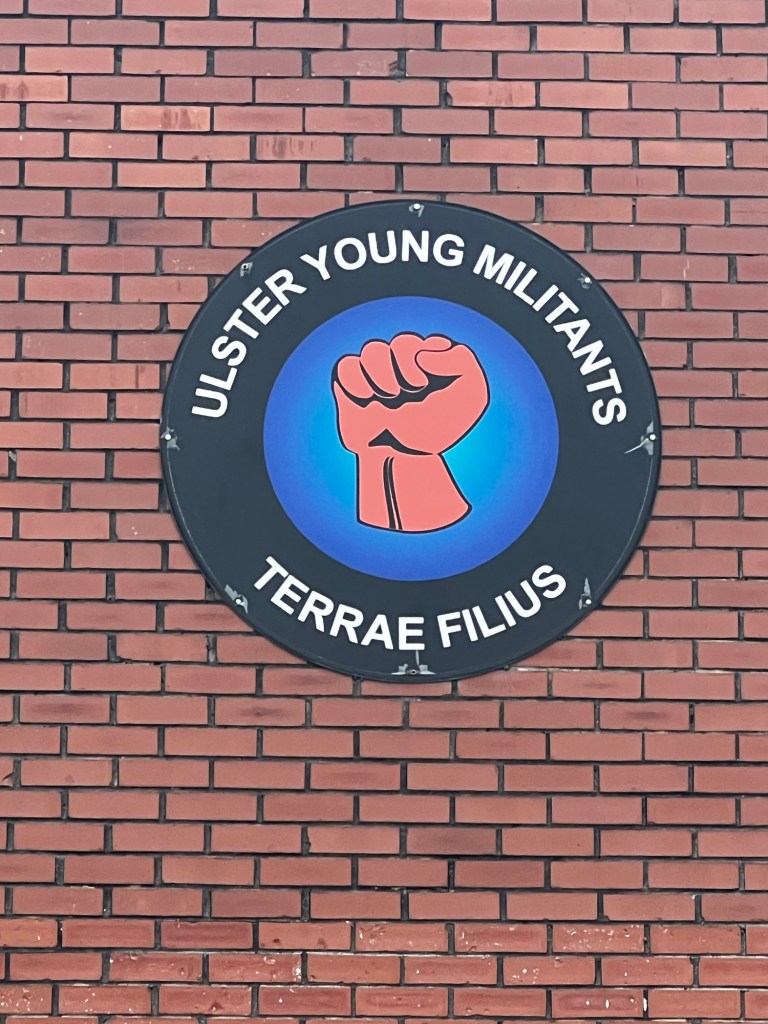
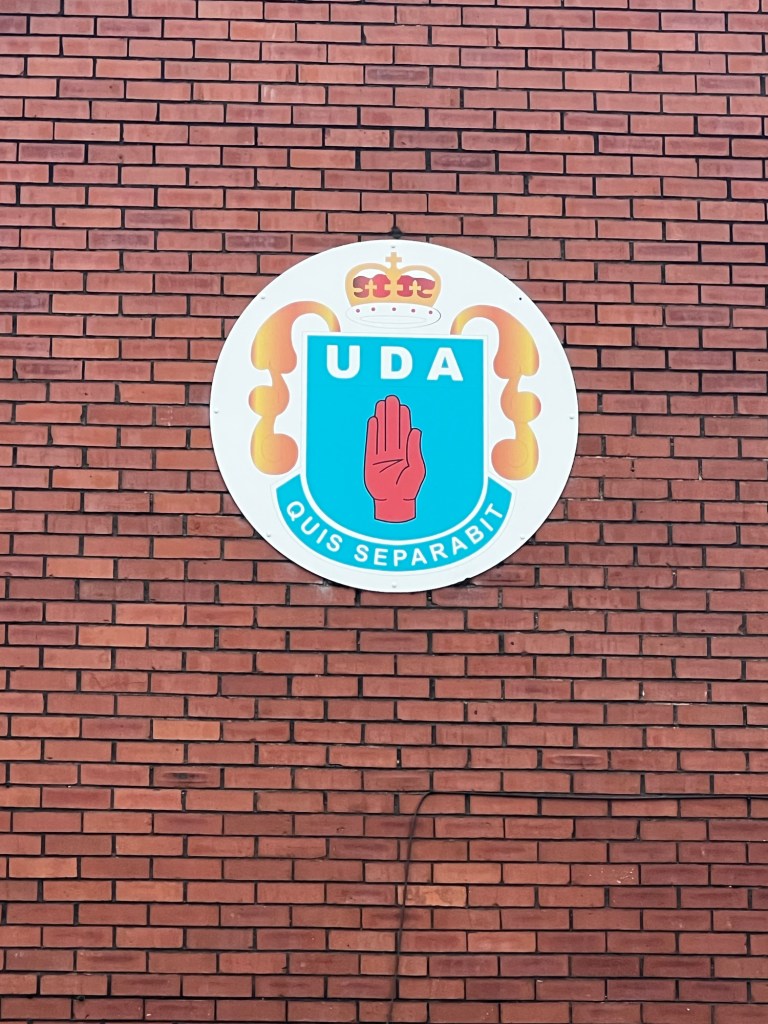
The Red Hand of Ulster is a symbol that represents the Irish province of Ulster and the O’Neill family. It is a red, open hand with the fingers pointing up, the thumb parallel to the fingers, and the palm facing forward. The Red Hand of Ulster is used in heraldry, on flags, postage stamps, pendants, and paramilitary banners.
The Red Hand of Ulster is believed to have originated from a mythical tale about two chieftains racing across water to claim the land. One chieftain cut off his hand and threw it onto the shore to claim the land before his opponent.
The Red Hand of Ulster is used by both communities in Northern Ireland, but it is more associated with the Protestant community. Catholics (Republicans) see it as representing the nine counties of Ulster, while Protestants (Unionists) see it as representing the six counties of Northern Ireland. The Red Hand of Ulster is also featured in the coats of arms of the counties of Antrim, Fermanagh, Londonderry, and Tyrone. County Louth also uses a right hand in its coat of arms, but it is skin colored to symbolize the hand of God.
The ethno-political division of Northern Ireland began with the Plantation of Scottish people and Northern England into Ulster as a means of suppressing the Irish culture and language -confiscating their land, forbidding the use and education of the Irish language, forced emigration . Essentially, ethnic genocide of the Irish.
 TerraTraveler