Trip 48
November 4, 2024
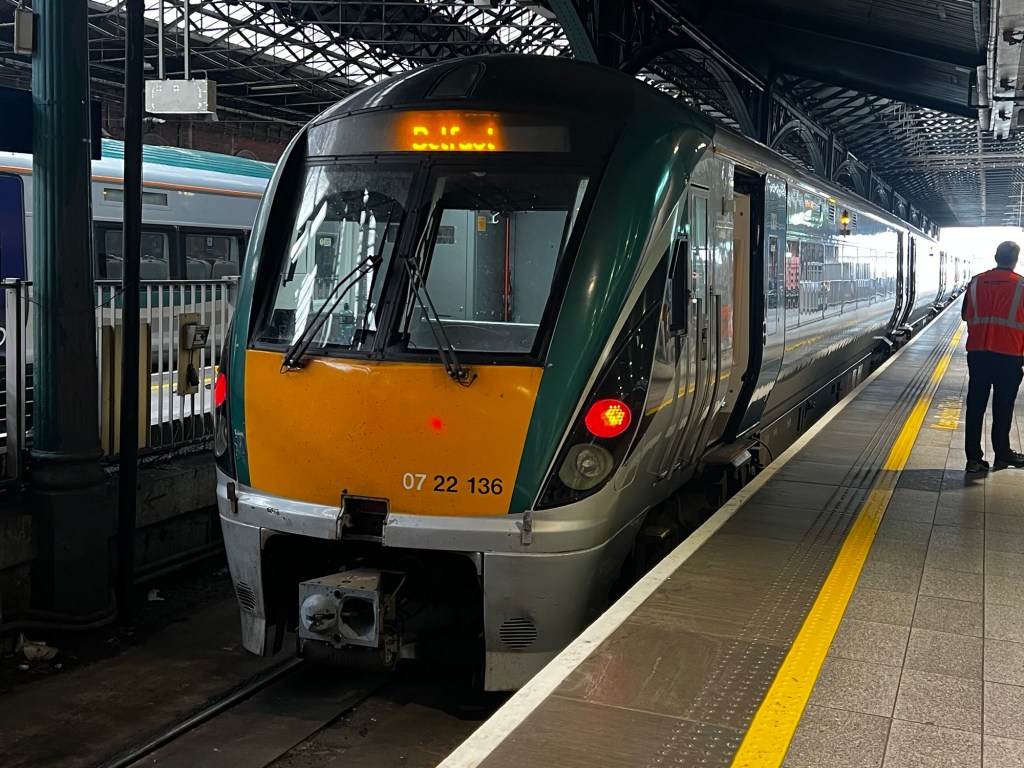
We took a midday train from Dublin’s Connolly station (Stáisiún Uí Chonghaile) to Belfast, arriving about 2:30. The Connolly station serves trains to the north and south-east of Ireland as well as the famous Irish high-speed train to Belfast (NOT our train!) . The Heuston station provides connections to the south and west of the country. The scenery along the way wasn’t particularly notable and it was a gray day, so not much to remark on about the trip except it was on time. It did seem like the terrain was more hilly as we moved towards Belfast though.
The name Belfast originates from the Irish Béal Feirste, or the mouth of the Farset, the river on which the city was built and which flows into the Lagan.
The train station at Belfast was under construction so we walked a few blocks to get to the pickup point for an Uber to the hotel, which is near the Titanic exhibit on the river Lagan. By the time we got checked in, it was 3pm and it gets dark at this time of year by 4:30, so we’ve not much time today for any big scale sightseeing.

The main commercial area is about 15 minutes’ walk from here and there’s a large shopping area called Victoria Place which reminds us (in design) of the Saint James Quarter in Edinburgh.

Unlike the US, retail shops here mostly close by 6pm, except Thursdays & Fridays. But, they’re getting ready for Christmas with trees and some of the shops in buildings nearby had lights being put up. The City Hall has crews out putting up stalls for the Christmas market.
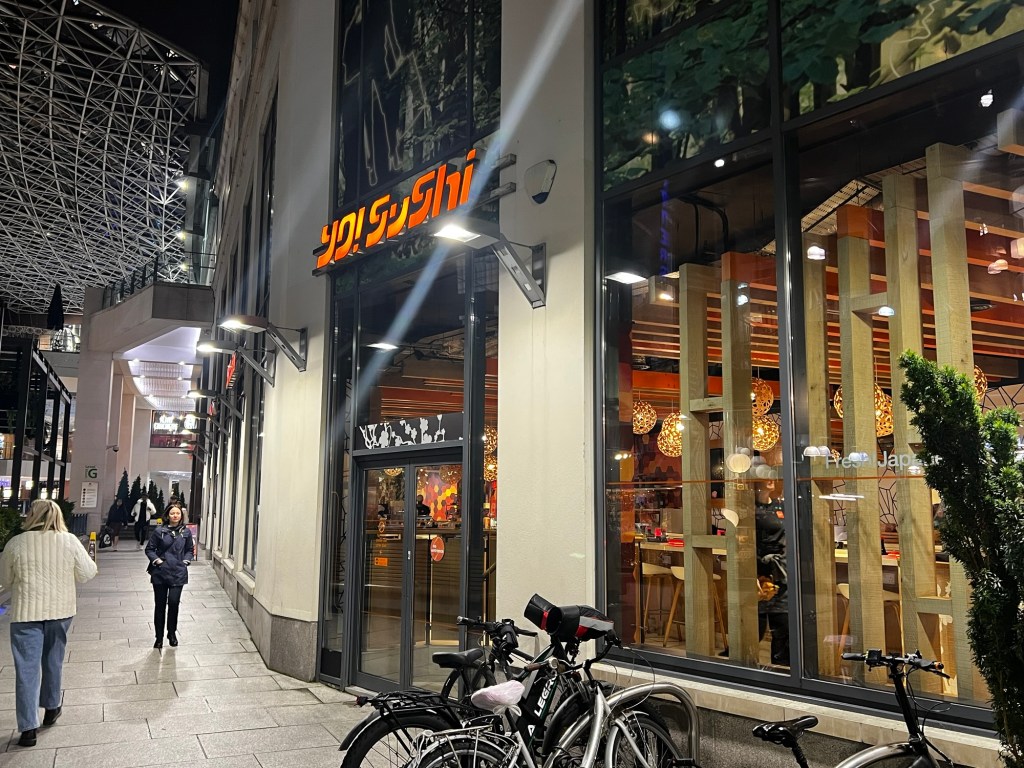
Even though Belfast is half the size in population of Dublin, it seems a bit more cosmopolitan in the area we’re in. I recognize a number of brands and restaurants, both from the UK and from the U.S., seemingly more than I remembered seeing in Dublin. There was even a Yo! Sushi (né Yo! Belfast) , which has apparently closed many of its locations in the area of London we frequent.

One of the earliest and most important undertakings of the Laganside Corporation, established by the British Government, was the Lagan Weir (a weir is a barrier built across a river to control the flow of water and raise the water level). Completed in 1994 at a cost of £14 million (equivalent to £27.02 million in 2023) the weir controls the level of water upstream. One of the main functions of the weir was to reduce unsightly mud flats at low tide. This was mostly successful, but mud flats are still evident on the river. The weir is a series of massive steel barriers which are raised as the tide retreats so as to keep the river at an artificially constant level.
 TerraTraveler