Trip 48
November 3, 2024
Tickets for Kilmainham Gaol are popular and we felt lucky to get tickets in the second to last tour of the day.
First built at the end of the 18th century, Kilmainham was built as a “reform “ jail, intended to reform inmates and replace the prior jail, which was largely a dungeon, mixing men, women, children in common rooms. Of course intent and reality weren’t entirely the same and the plan to have one person per cell didn’t always work as planned with (at times) terrible overcrowding. The tour guide related that some cells had as many as five men in an 8’x10’ cell and women and children prisoners (yes, children prisoners ) sleeping in the hallways on the ground on straw.
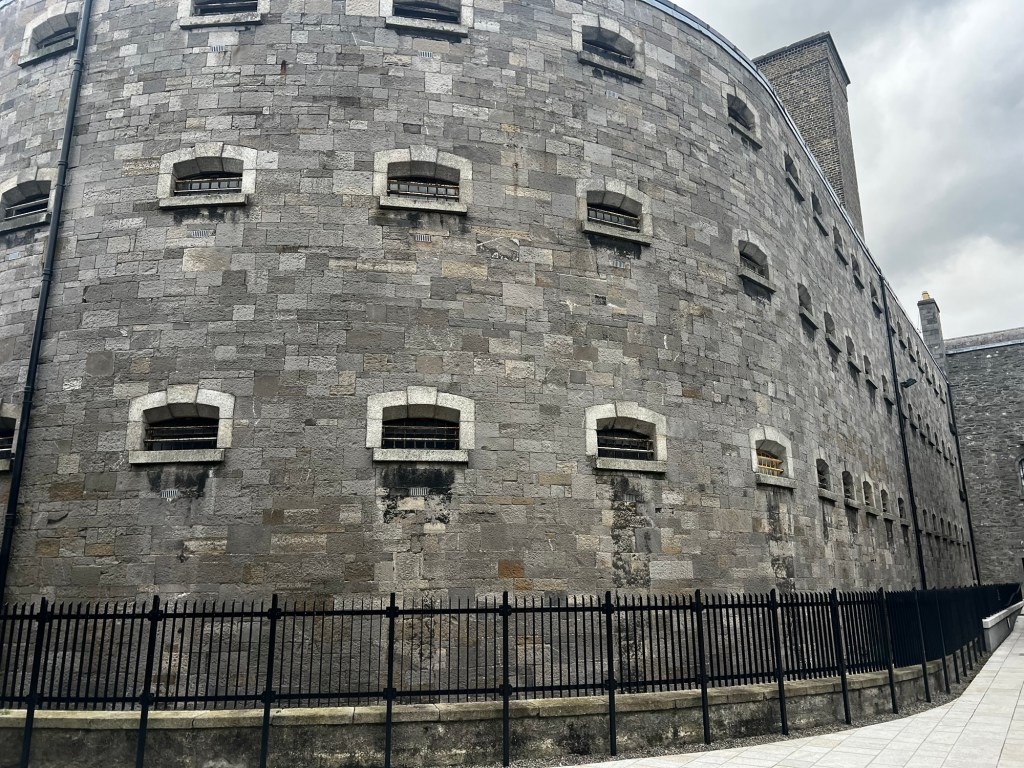


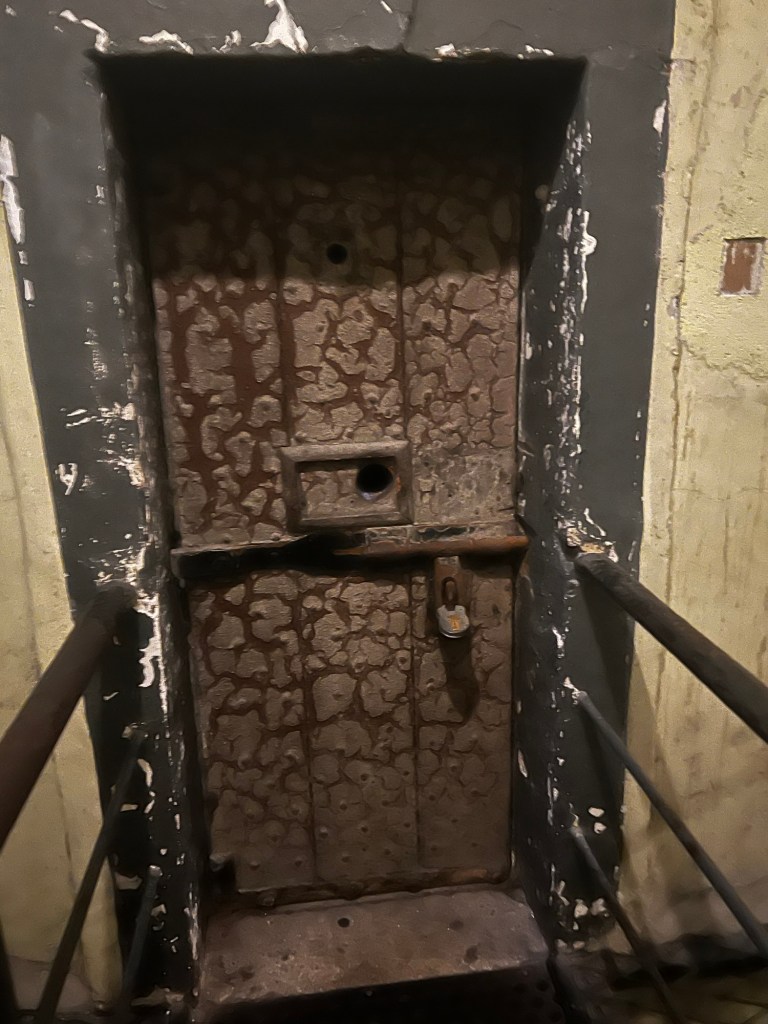
The prison held both those convicted of crimes (some just petty theft) as well as political prisoners. The petty criminals were ordinary citizens who mostly stole food during the great famine (mid 1840’s-1852) when over 1m died from starvation and the population fell by 20–25% due to death and emigration. Many of the adult prisoners were transported to Australia. The population of Ireland on the eve of the famine was about 8.5 million, by 1901 it was just 4.4 million. Even now in 2024, a hundred + years after the beginning of the famine, the population is 5.25m. The reason poor Irish peasants were so poor and had to rely on subsistence farming potatoes is due to British land seizures and unfair economic policy. So Ireland had enough food for everyone, but potatoes were the only food accessible to a large portion of the population because of British policies.
Due to the famine, many turned to begging in the streets. The government responded by making this a criminal offense, with the result that many were imprisoned for stealing food or begging. The tour guide related that the youngest prisoner was 5 years old.
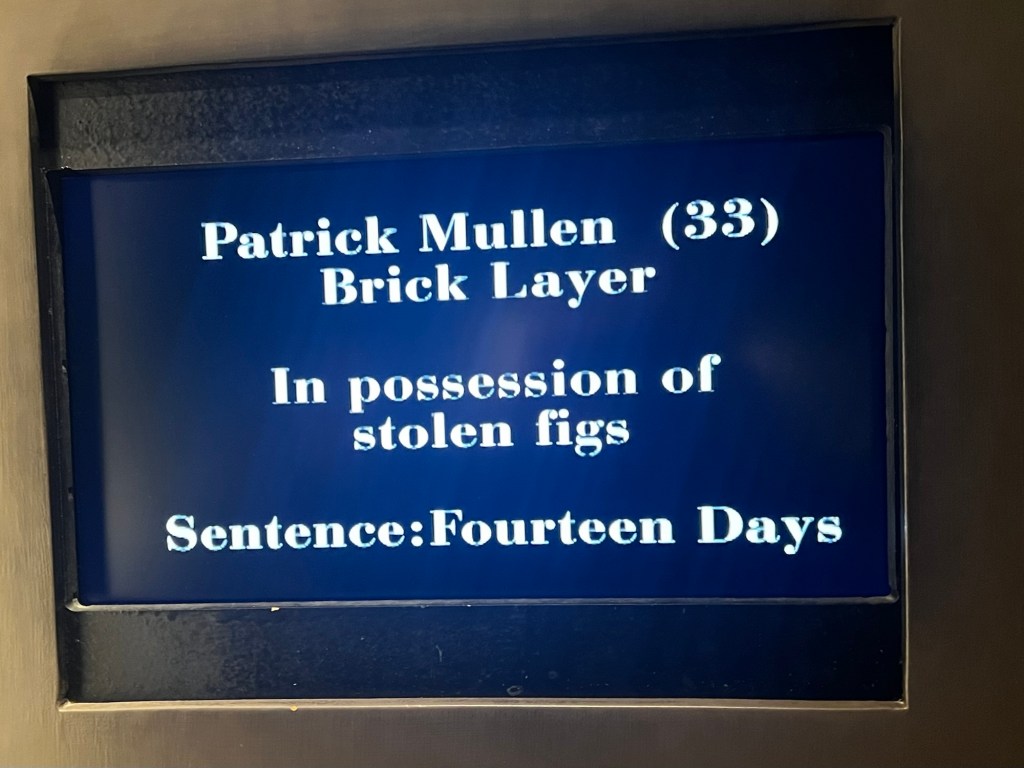

So both the children stealing bread or others stealing food in order to survive, were mixed in with convicted murderers and those convicted of serious crimes.
There was an expansion of the prison in 1841 that was a substantial change in design.
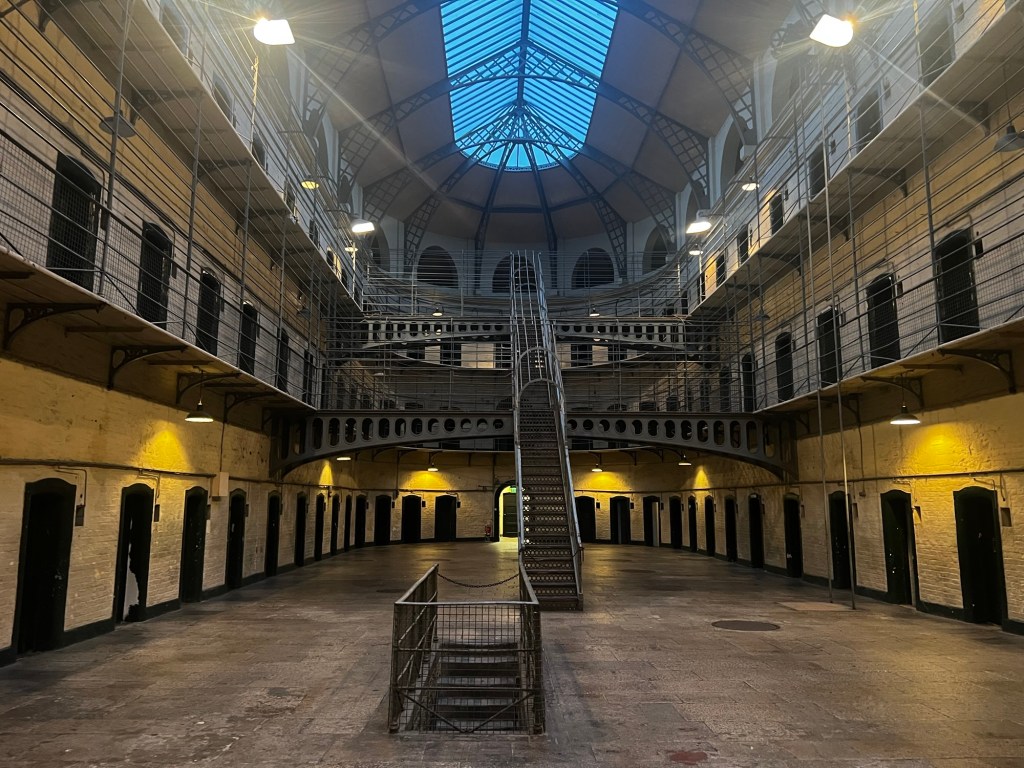
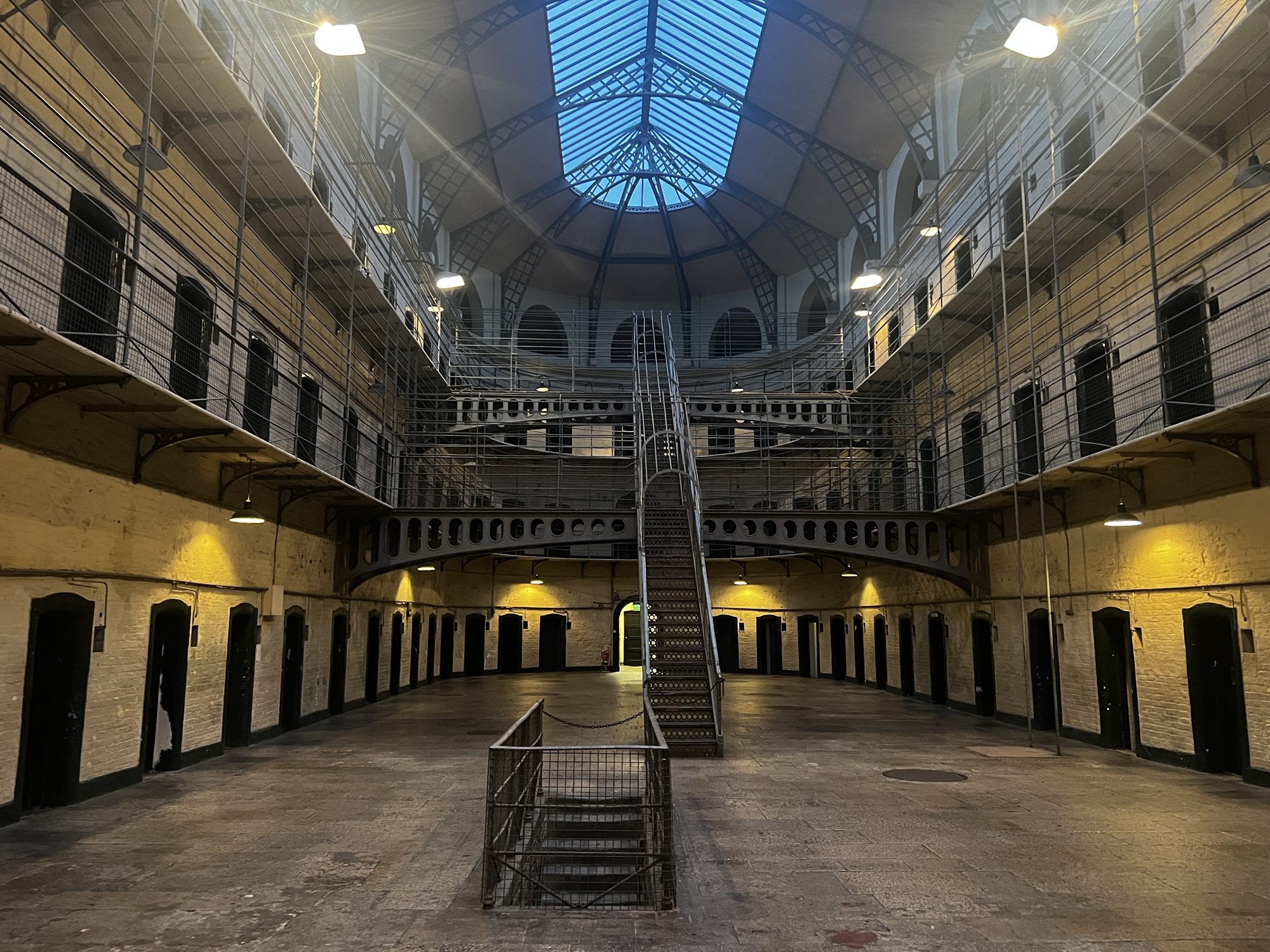
The extension at Kilmainham shows many of the features of the model for virtually all Victorian prisons – Pentonville in London, completed in 1842. The elimination of corridors and their replacement with catwalks in a vaulted space surmounted by a skylight was pioneered at Pentonville. This design combined separate confinement with the greatest possible level of inspection by prison staff. Victorians believed that the light from the glass roof would help bring God closer to the inmates, but if you were going to be isolated for some infraction, it was in an underground cell in the dark. This scene has been used in many movies.
The cells were located on three levels, with the kitchen and laundry located underground, where the women and children worked; food was raised up via a dumb waiter.
Criminals from the civilian populace who were sentenced to death were hanged at the main entrance to the Gaol, supposedly to deter others, but it became enough of an amusement event (hundreds would gather to watch), that the executions were moved inside out of public view.
Political prisoners sometimes had better quarters and food, but military prisoners from the Easter Rising were also held and executed here by shooting squad. The Easter Rising of 1916, as part of the effort to achieve Ireland’s independence from England, resulted in thousands of arrests and imprisonment at Kilmainham. After military trial, some 14 of the leaders were executed (firing squad) here. While the Rising was not initially supported by the general population (many Irish men had volunteered for service in World War 1); once news of the executions became common knowledge, the opinions of support for the rebels and independence shifted.
One of the most dramatic escapes from Kilmainham Gaol took place in 1921 at the height of the Irish War of Independence. The Gaol was being used as both a British military barracks and a political prison at the time. Three of the prisoners – Ernie O’Malley, Patrick Moran and Frank Teeling – urgently seeded to escape. Teeling was facing execution, while Patrick Moran’ trial was imminent and he could expect the death penally if found guilty. O’Malley was also a wanted man. He gave a false name on his arrest, but he felt it was only a matter of time before his real identity was discovered. They were later joined by Simon Donnelly who arrived in the Gaol just days before the eseape look place. He was a senior member of the Irish Kepubliem Army (IRA) and getting him out of Kilmainham was deemed a priority.
Some British soldiers guarding the men agreed to help them with their plan, and smuggled a bolt-cutting tool into the Gaol.
On the evening of Monday, 14 February they managed to break the lock on the west gate and Donnelly, O’Malley and Teeling escaped to freedom. However, at the last minute. Moran decided to stay behind. He told Ernie O’Malley that if he escaped he felt he would be letting down the witnesses who gave evidence in his defence. There were also concerns that the plan would not succeed if too many people tried to eseape at once. Although he was confident he would be acquitted, Patrick Moran was sentenced to death and executed in Mountjoy Prison on 14 March, 1921. The escapees were never recaptured.
March, 1921. The British military held a formal inquiry into the incident in Kilmainham Courthouse and two soldiers, Privates Ernest Roper and James Holland, were court martialled and imprisoned for aiding the prisoners in their escape.
Though the Easter Rising rebellion was quelled, it did not quell the push for independence. On 14 December 1918, the final United Kingdom general election was held throughout Ireland, It was a key moment in modern Irish history, seeing the overwhelming defeat of the moderate nationalist Irish Parliamentary Party (IPP), which had dominated the Irish political landscape since the 1880s, and a landslide victory for the radical Sinn Féin party. Sinn Féin had never previously stood in a general election. The party had vowed in its manifesto to establish an independent Irish Republic. In Ulster, however, the Unionist Party was the most successful party. This presaged the ultimate division of the island between the Republic of Ireland and Northern Ireland after the Irish War for Independence. A bloody war on both sides endured from 1919 to 1921. In May 1921, Ireland was partitioned under British law by the Government of Ireland Act, which created Northern Ireland.
Kilmainham jail was decommissioned for use as a jail in 1924 and it was a matter of debate as to whether it should be torn down or kept as a symbol of the struggle for national independence. It sat and deteriorated for decades until a restoration society was formed in 1960 and opened to the public on 10 April 1966.
What caused the Irish pita famine and where did it come from? The possible answers may surprise.
The pathogen that caused the Irish Potato Famine (1845-1852) was Phytophthora infestans, a water mold that causes potato late blight disease. It likely originated in the Toluca Valley of central Mexico, which is considered the center of diversity for both this pathogen and wild potato species.
The strain that caused the devastating famine first appeared in North America, specifically in the United States and Canada, in 1843-1844. It then spread to Europe, arriving first in Belgium in June 1845. From there, it quickly spread to other European countries, reaching Ireland in September 1845.
The Mexican origin makes sense ecologically, as this is where potato plants and P. infestans co-evolved over thousands of years. In Mexico, wild potato plants developed some resistance to the pathogen, and local P. infestans strains existed in a more balanced relationship with their host plants. However, when the pathogen reached Europe, it encountered potato crops with no natural resistance, leading to devastating consequences.
The exact path of how P. infestans traveled from Mexico to North America and then to Europe is still debated by historians and scientists, but it’s believed that infected potato tubers carried on trading ships were the most likely vector.
 TerraTraveler