Trip 48
October 31, 2024
We’re making a shortish trip to Ireland (both The Republic and Northern Ireland ), landing in Dublin. The modern Irish Éire evolved from the Old Irish word Ériu, which was the name of Ireland and of a Gaelic goddess. Ériu is generally believed to have been the matron goddess of Ireland, a goddess of sovereignty, or simply a goddess of the land. Éire is Irish (Gaelic) and Ireland, the English equivalent. Street signs are in dual English and Gaelic, though I’ve heard no Gaelic spoken as yet.
We arrived about 8:30 am on a connecting flight from Philadelphia, so that flight was shorter than our accustomed 8-9 hour flight from the US to Europe. ETIAS is not yet in effect, so it’s just the usual queue to immigration and still, getting the passport stamped.
Rather than take the airport bus, which takes an hour and a half (due to all the stops it makes), for a couple of € more, we took an Uber and it was 30 minutes.
The River Poddle (Poddle was the main source of drinking water for the city for more than 500 years, from the 1240s) and the Cross Poddle joined and went on to form the Black Pool, “An Dubh Linn” from which Dublin drew its name.
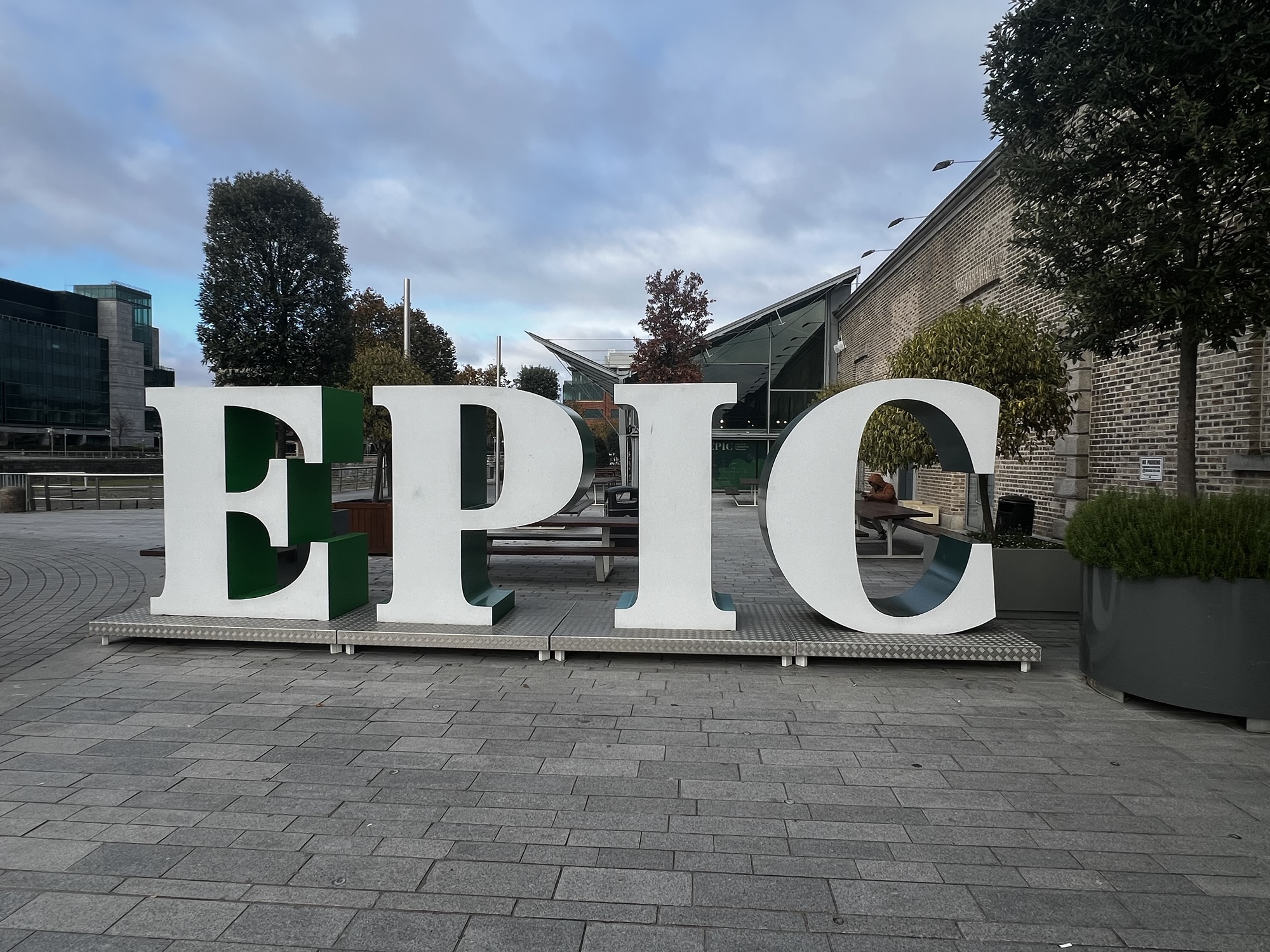
The hotel room was not ready as it was early, so we had already planned to visit the EPIC museum (museum of Irish immigration) that looks out on the Liffey River. We pre-booked the museum entrance so all we needed was a way of getting there. We bought a city bus pass at a nearby grocer; 6 stops later, we’re there.

It’s truly impossible and not my intent to recount the history of Ireland as a country (Republic of Ireland) , divided country (Northern Ireland) , and at times, as part of England. The museum is a series (20 different rooms) of displays around the history, people, culture of Ireland. In each, after viewing the display, you can “stamp” your museum passport. As an American long distanced in history from the events that shaped the formation of the Republic of Ireland and the division of Northern Ireland (as part of the United Kingdom), it’s fascinating, difficult and sad to see how much the domination of England under Cromwell and the religious strife that’s (mostly) boiled under the surface (except for the period of “The Troubles”) lasting hundreds of years, accompanied by periods of famine (the Potato Famine of 1845 that killed 1m people) and economic chaos, led to the emigration (YouTube) of millions of Irish.
Anchored along the river across from the museum is the replica of the Jeanie Johnston. The Jeanie Johnston is a “famine ship” , carrying emigrants from Ireland. The ship made a voyage from County Kerry to Quebec on 24 April 1848, with 193 emigrants on board, as the effects of the Great Famineravaged Ireland. Between 1848 and 1855, the Jeanie Johnston made 16 voyages to North America, sailing to Quebec, Baltimore, and New York. On average, the length of the transatlantic journey was 47 days. The most passengers she ever carried was 254, from Tralee to Quebec on 17 April 1852. To put this number in perspective, the replica ship is only licensed to carry 40 people including crew. On average, the length of the transatlantic journey was 47 days.

It’s Halloween here (well, anyplace that celebrates). While it gets dark early (4:30) , fireworks started going off in early evening. These weren’t organized fireworks displays; we could hear the sounds of explosions nearby and there were occasional aerial bombs; rather unexpected in a highly urban area.
We walked outside to see if we could locate some of the fireworks, but they were too distant. Our hotel is within a block or so of Saint Patrick’s Cathedral (founded in 1191 as a Roman Catholic cathedral) and there was a long line of people waiting to get in, apparently for a concert; a number of people and children were dressed in Halloween outfits.
Two counties in Ireland lay claim to being the birthplace of Halloween – Berry and Meath. Halloween might have begun as an old Celtic festival. Celebrating the cycles of nature (and Halloween generally is in the time of year when harvests are complete), one such festival to develop was Sambian, marking the end of the pastoral cycle and that the thin veil of this transition period between the world and the world of the dead grew thin, allowing departed spirits to return.

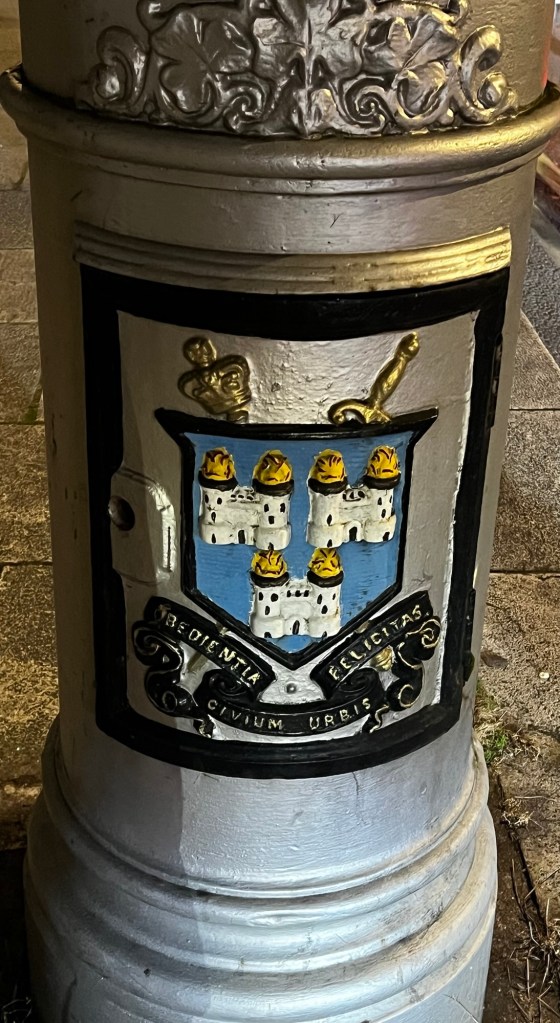
The coat of arms of Dublin, Ireland is a symbol of the city that has been in use for over 400 years:
- The shield: Features three burning castles
- The figures: Two female figures flank the shield, one representing Justice and the other Law
- The motto: Obedientia Civium Urbis Felicitas, which translates to “the obedience of the citizens produces a happy city”
- The flowers: Groups of flowers below the shield represent hope and joy.
The three burning castles have been a symbol of Dublin since the Middle Ages, and are shown on the city seal from the 13th century. The flames symbolize the citizens’ readiness to defend the city, but are not a depiction of a real fire. The origin of the castles is unknown.
I noted that in the city center, there are a number of electric vehicles, many of them taxis (but certainly not all), with Tesla, VW , Kia and Mercedes represented. I wondered how much electricity costs here. It’s really (compared to my own costs) expensive at around $0.34/kWh; Over the past 12 years, electricity prices in Ireland have almost tripled. Electricity in Ireland is generated mostly by natural gas (affected by the Russian gas embargo) , but households have electricity bills of >€1300! Gasoline is expensive too, at about $7/gallon, though with this price, charging an EV makes economic sense. Using my own EV’s efficiency (Wh/mi), this would make charging costs about 9¢/mile (bit more than double my own) , but even with a high mileage gas car, gas costs/mile would be 17¢/mile. Dublin is the most expensive city to live in Ireland.
 TerraTraveler