Trip 47
September 3, 2024
As many times as we’ve been to Ansterdam, we’d never visited the Royal Palace (Koninklijk Palace) , which is quite literally the jewel in the crown. Although no longer home to the Dutch Royal family, this 17th century building is still used to hold official receptions. The Dam derives its name from its original function: a dam on the Amstel River, hence also the name of the city of Amsterdam. The town hall was originally built in approximately 1270, the dam formed the first connection between the settlements on the sides of the river.
As Amsterdam grew in population and global trade importance, the old city hall was deemed not worthy by the city’s burghers of the status of the city. A new city hall was commissioned, and would be five times larger at 20,000 square meters (215,000 square feet). Built starting about 1650 on the site of the former city hall, using 13,600 wooden piles driven into the marshy sand to a depth of 12 meters (the first layer of sand) by a pile driver that weighed 1400 lbs , each pile had to be manually driven into the sand. Construction took 60 years. The completed town hall became the largest public town hall in Europe at the time. The city hall was construction started following the end of the 80 Years War between the Dutch Republic and the Spanish.
But how does a town hall become a palace? On 20th April 1808, Louis Bonaparte made his triumphal entry into Amsterdam. His brother, Emperor Napoleon, had made him King of Holland in order to increase his influence from France. The new king found only one building suitable to be his palace in the Netherlands:
The Amsterdam Town Hall. the town hall was transformed into a stylish palace. Thick carpets were laid on the floors of cold offices and galleries and the walls were decked with colourful fabrics. The dungeons became wine cellars and in the middle of the façade on the first floor, he had a balcony built.
After two years, King Louis Bonaparte fell out with his brother. He was doing too much for the Dutch and too little for the French Empire. In 1810, he stepped down from the throne and the Kingdom of Holland was annexed by France.
After the fall of Napoleon in 1813, Prince Willem of Orange, later King Willem I, returned the palace to the city of Amsterdam. After his investiture, however, the new King realised the importance of having a home in the capital and asked the city authorities to make the palace available for royal use once again, but it was not until 1936 that the building became state property.
The entrance fee (12.50€) for the palace includes a free audio guide, keyed to the numbered rooms.
The Citizens’ Hall (the Burgerzaal), contains the universe in miniature: 2 maps of the world are embedded in the floor flanking a representation of the skies of the northern hemisphere.
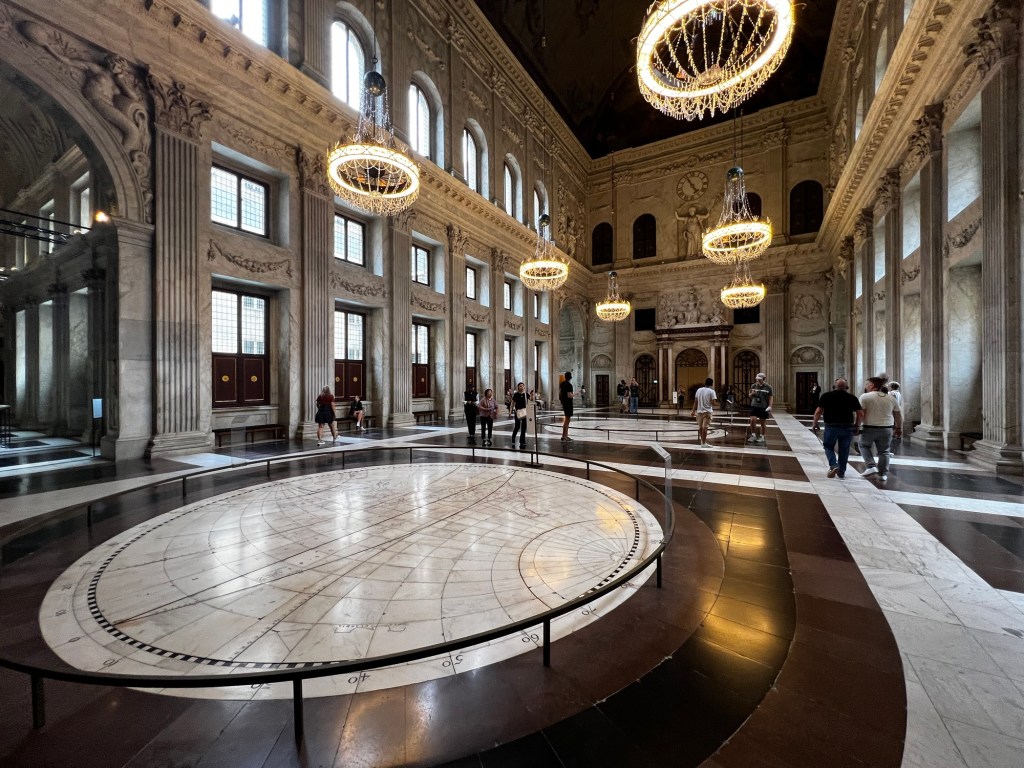
The Burgerzaal is where State dinners are held, and the hall is transformed into a gigantic dinning venue accommodating up to 250 guests- the floors are covered with carpets, and tables set.
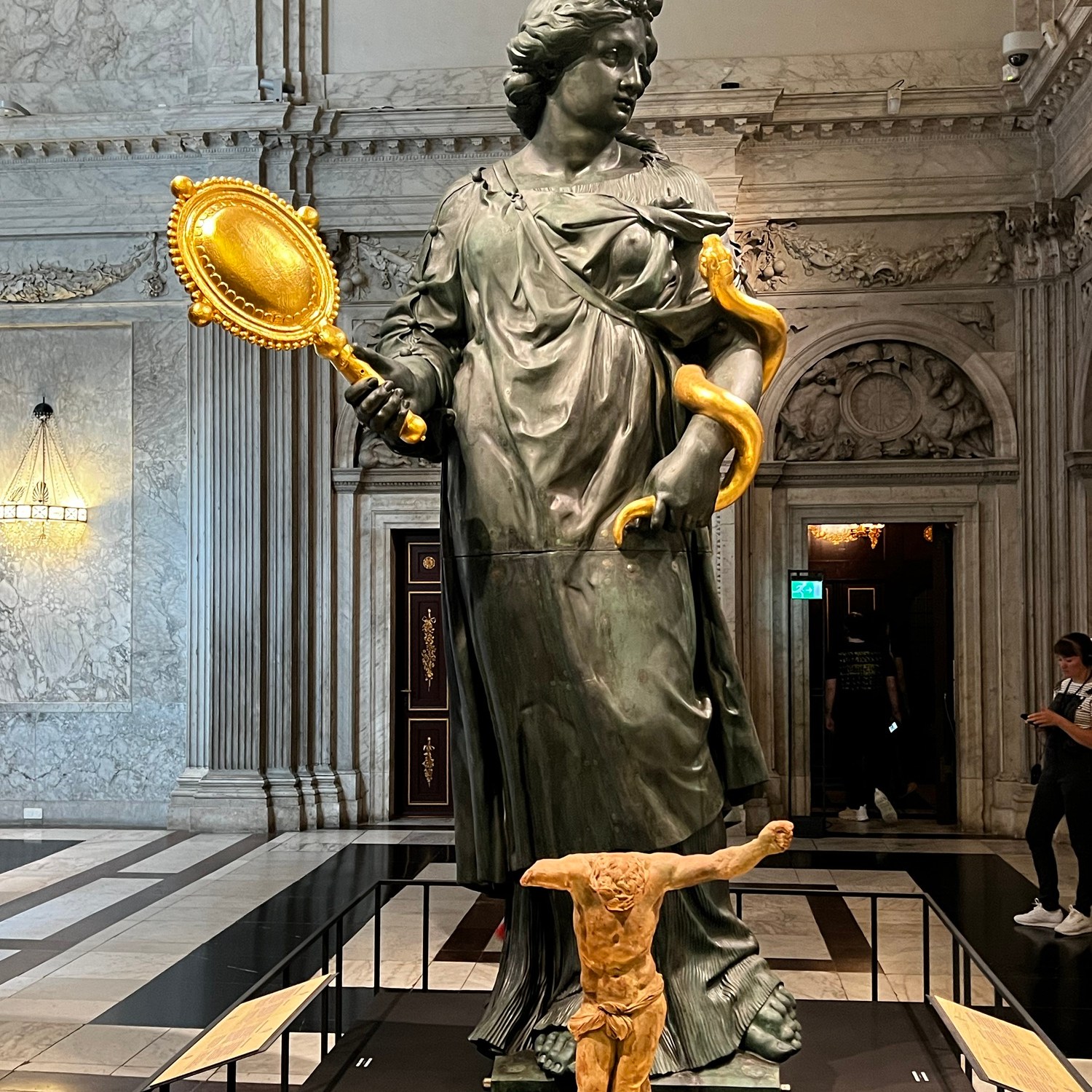
Main statues around the Burgerzaal: Peace (east, Dam square side), Prudence (southeast), Justice (northeast), Atlas (west), Vigilance (southwest) and Moderation (northwest).
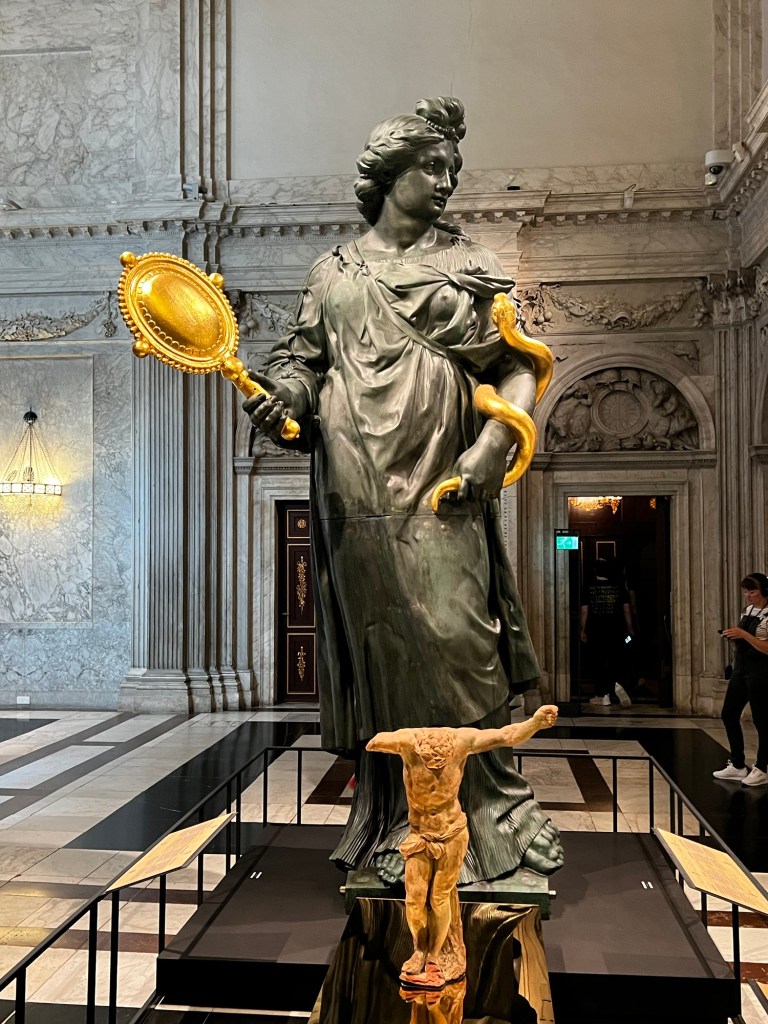

It was said that if Atlas dropped his burden of the world, the city of Amsterdam would fall. At the opposite end of the Burgerzaal is a statue of Peace.

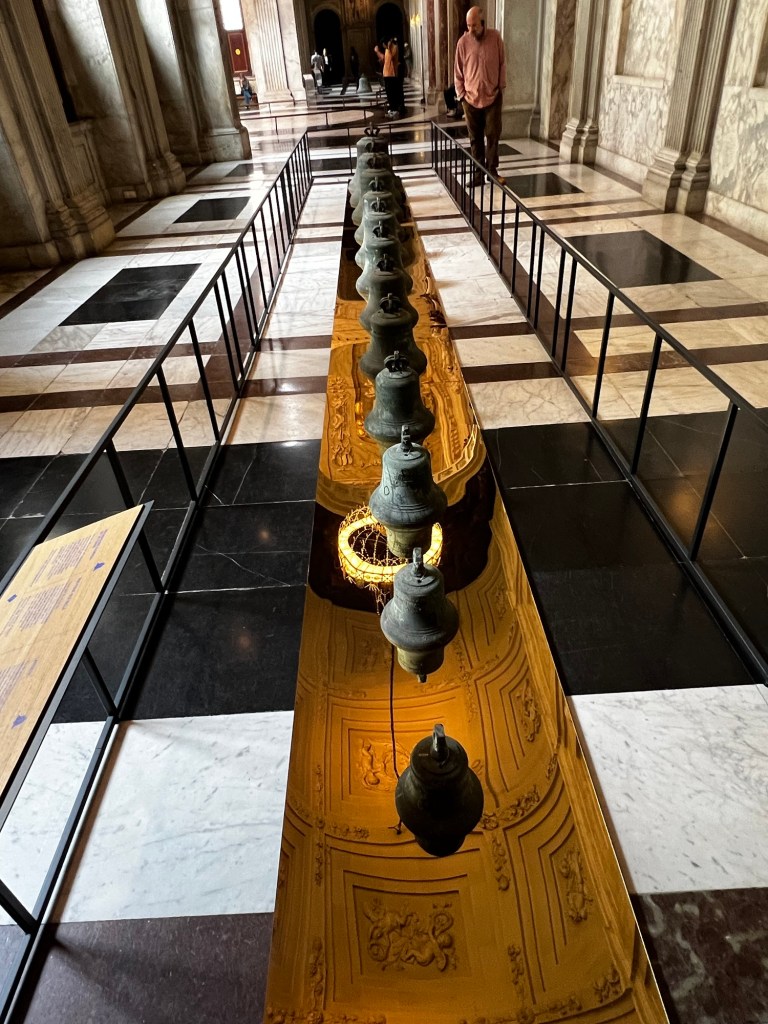
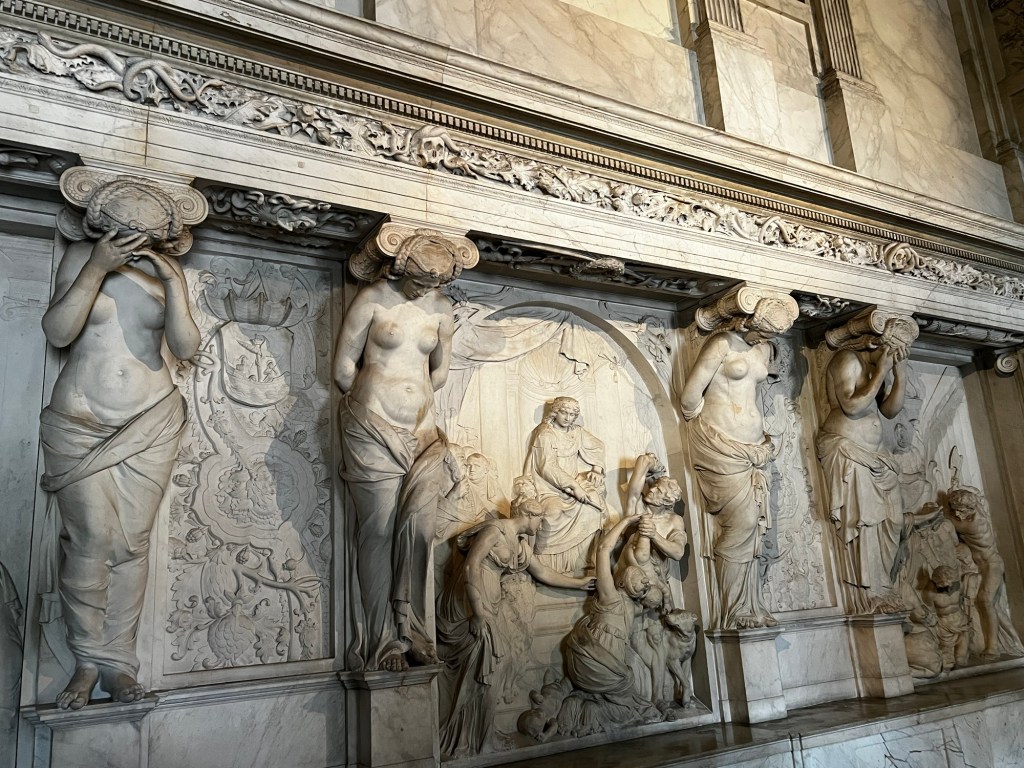
We also visited the Vierschaar, a tribunal where death sentences were publicly pronounced, four times a year. A Vierschaar (Foursquare) was an early Germanic form of judiciary, where benches and ropes would create a square space for justice to be handed out by one judge and 9 aldermen, with the defendant in the center. The mayors, seated in the Mayor’s Room, followed the death verdicts through an opening. After the trial the prisoners went to the Justice Room, where they were passed through an opening in the wall to the gallows on Dam square.
On the walls are three reliefs: the sentence of Roman council Lucius Junius Brutus, Greek King Zaleucus and biblical King Solomon, representing impartial, compassionate and wise sentences. The large female figures on the wall symbolize Death, Penitence, Justice , Original Sin.
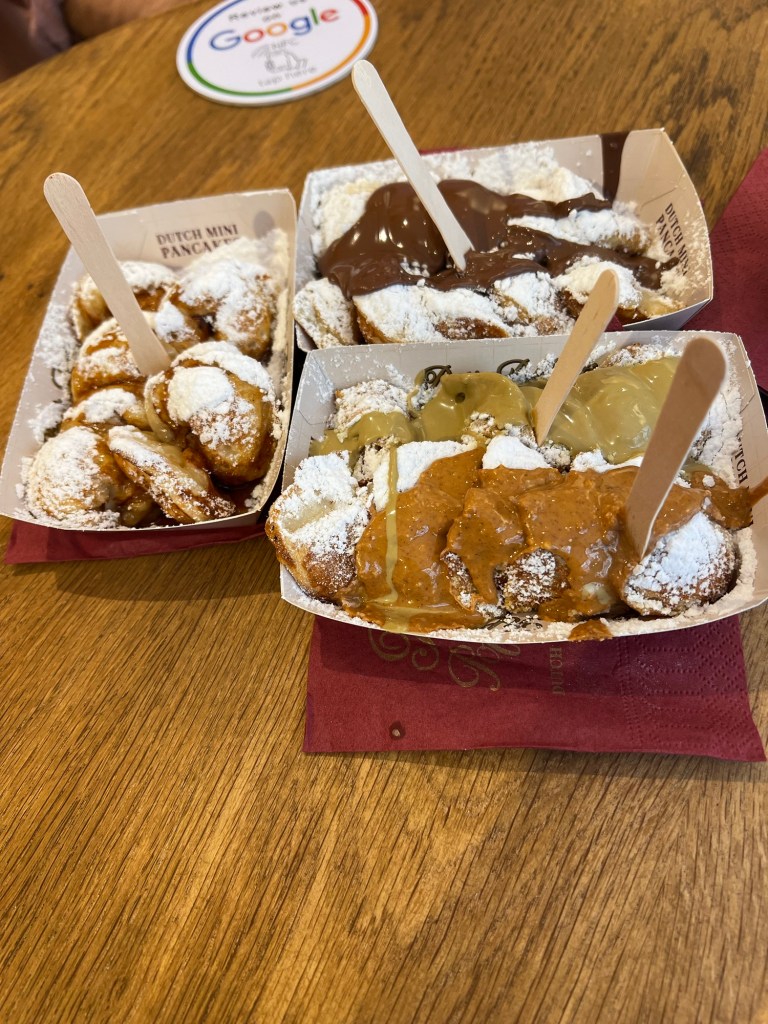
Afterwards, we treated ourselves to some small Dutch pancakes- profiteroles, at Pat’s Poffertjes.
From here, we took the tram around to P.C. Hooftstraat to find the Mont Blanc boutique. The street (“straat”) is a veritable list of all the top end retailers. By the time we’d made our purchase, it was starting to drizzle, so we took temporary refuge in the park in the Leidesplein, then hopping onto a crowded tram to transit back to Centraal and then our hotel.
 TerraTraveler